A Middle Ground of Co-Creation
By Clayton Campbell
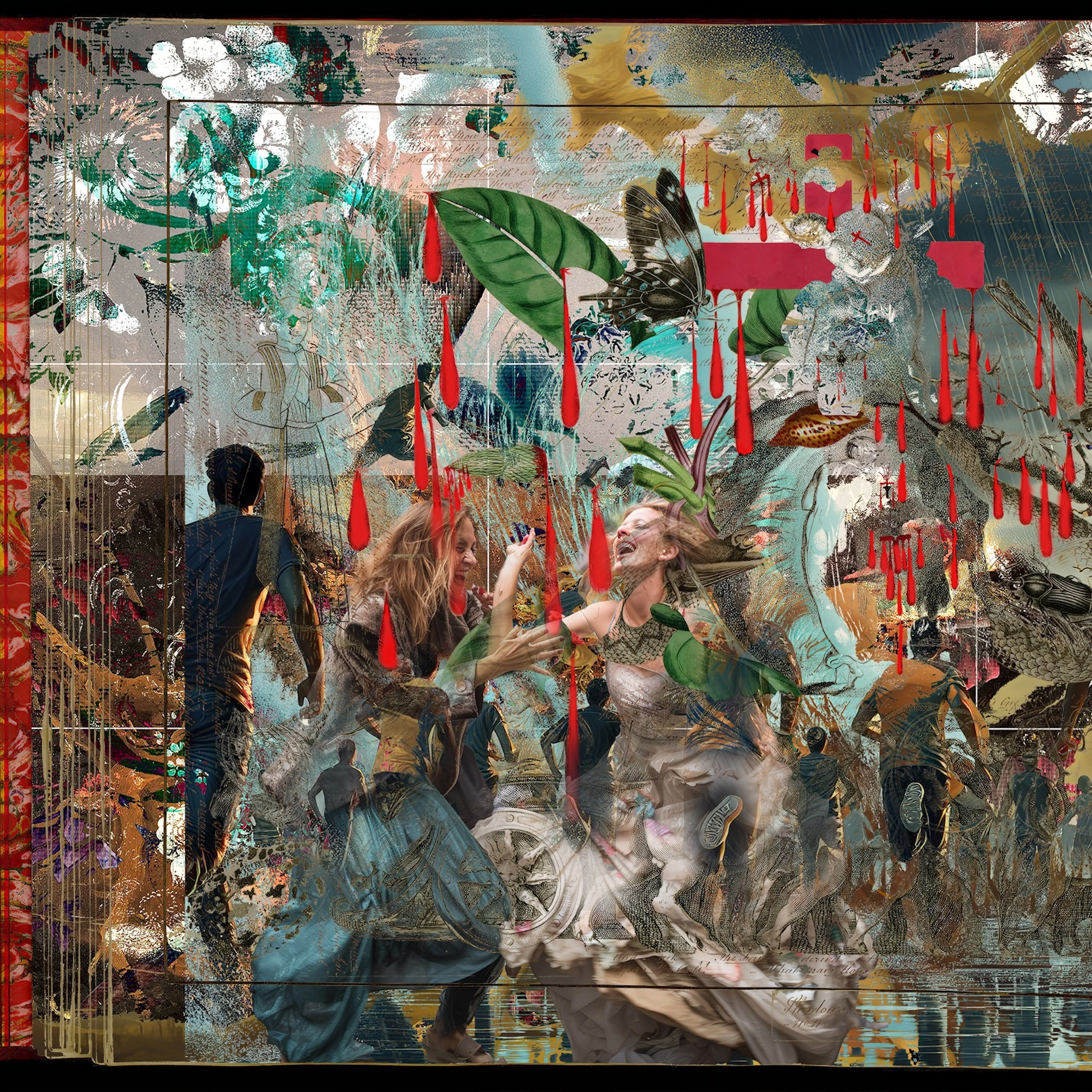
Anthropocene Blood Book 16
I. Painting, Photography, and Artificial Intelligence in the Studio
My path to making AI assisted artwork did not begin with machine technology, it began with drawing and painting. I studied at the Arts Students League in New York, attending Robert Beverly Hale’s (the first curator of contemporary American Art at the Metropolitan Museum of Art) life drawing class. Hale was a proponent of Jean-Dominique Auguste Ingre’s belief that “Drawing is the honesty of Art.” There is a connection between Hale's philosophy and his museum career. Even though he spent his days teaching classical draftsmanship, as a Met curator he was purchasing Autumn Rhythm drip painting by Jackson Pollock. Hale did not see this as a contradiction; he believed that once an artist completely understands the formal discipline of drawing, they earn the artistic right to deconstruct it, abstract it, or break the rules. I never forgot this, and I learned from Pollock’s automatic methods and controlled accidents. They would have a lasting impact on my approach to artmaking.
A few years later I apprenticed in Vienna, Austria with the Fantastic Realist artist Ernst Fuchs. With Fuchs spoke about the need to ‘see’ the energy in a seemingly inanimate object, which seems somehow prescient when thinking about AI. He taught me to paint by building up an accumulation of layers. They created unique optics and visual relationships that defined his mixed egg tempera and oil painting technique. By alternating paint layers, thin over thick, I could later would make a logical transition to Photoshop, which is based on the concept of layers.
Growing up in the greater New York City area, I was exposed to many artists using technology including Robert Rauschenberg, James Rosenquist, Andy Warhol, Marisol, and Lucas Samaras. I had begun to use photography long before digital tools entered my studio. My first cameras were for research: gathering visual fragments, documenting places, observing human behavior, and collecting the raw material from which my paintings, drawings, and mixed media projects would emerge. I frequented the Pictures Collection Archive at the New York Public Library on 5th Avenue and 40th Street. It was a favorite resource for artists and designers where they could access public domain images. Using pictures archives is a resource I still access with online sites like Picryl and Wiki Commons.
I bought a xerox machine with a sliding bed so I could experiment with distorting imagery and to make self-publishing projects. I participated in collaborative mail art projects and was a member of Louise Odes Neaderland’s International Society of Copier Artists. She helped establish Xerox machine technology as a legitimate medium.
I worked with black and white photostats of my xerox art and had them made at Giant photoshop company in Union Square, New York. I turned them into one-of-a-kind mixed media prints, working on their surfaces with photo oil paint, dyes, spray paint, and stencils. Photography and machine technologies were never separate from my practice, functioning as a partner medium—a way of studying light, composition, atmosphere, and the complexities of lived experience in a turbulent socio/political environment of the 1960s and 70s.
I am a digital immigrant, born before computer technology. Yet, as computers were introduced, digital camera evolved, and rudimentary visual applications like Photo Deluxe appeared, my practice gradually shifted. The photograph moved from being a preparatory tool to becoming a primary material. Layers of paint gave way to layers of pixels. The compositional thinking remained similar, but the surface changed. What had once occurred through the physical accumulation of pigment increasingly unfolded through montage, masking, blending, redaction, and reconstruction within digital space.
Seen from this perspective, my engagement with machine learning is not a rupture with painting and drawing but part of a continuous evolution that extends across five decades. I paint and draw with photoshop electronically. The underlying themes remain stable: memory, perception, narrative construction, human vulnerability, spirituality, and the search for meaningful visual form. The tools have changed; the questions have evolved and been refined.
II. Technology and Advancement
Sometimes I consider how technological advancements have repeatedly disrupted the artistic status quo, causing a redefinition of authenticity, commodified value, and human authorship. If I look at technological change beginning in the fourteenth century when slow drying oil paint replaced egg tempera, it enabled a level of blending and light that shifted art toward lifelike realism. Centuries later, the introduction of premixed tube paint and portable easels similarly decentralized art production, as artists could move between enclosed studios into the light with outdoor painting.
As the post-war era progressed, new mediums continuously blurred the lines between commercial and fine art. The invention of the airbrush mechanized paint application, transforming graphic design and pop painting. The creation of fast-drying synthetic acrylic paint gave Abstract Expressionists the ability to work at an unprecedented, rapid scale without waiting months for oil layers to dry.
The invention of the printing press broke the monopoly of wealthy patrons on image ownership. Artists could mass-reproduce and sell prints directly to the public as the press democratized visual culture for the first time. Stone lithography, plate lithography, etching, engraving, photogravure and offset printing transformed image reproduction with the rise of mass media newsprint. Artists would work with all of these technologies. Print media evolved again in the mid-twentieth century with the rise of Xerox photocopy technology. Bypassing high-cost traditional publishing houses, xerography allowed artists to instantly self-publish zines, democratize information, and easily appropriate mass media for social commentary. Social media arrived soon after the internet’s appearance with on-line zines, Substack, Facebook, Instagram, websites, and it continues to unfold.
In terms of how we see things, a long-standing focus on capturing physical reality was upended in the nineteenth century by the invention of analog photography. It took a long time to accept that anything made by the camera was fine art, yet it did help make documentary painting obsolete. The cameras presence encouraged artists to move away from strict realism and invent radical abstract movements like Cubism to capture what the lens could not. Photography has experienced its own massive disruption with the transition from analog chemical processing to digital sensors.
This shift eliminated the darkroom, democratized the medium for the masses, and ignited intense debates over image manipulation and the objective truth of a photograph. But the single biggest technological shift that made AI possible was the advent of the computer in 1951, followed by the release of the first commercially available personal Apple computer in 1984. By the late twentieth century, the artistic canvas had migrated entirely into virtual space with the introduction of digital painting software and graphic tablets. Armed with pixel-based canvases and the "undo" command, a new generation of creators entirely transformed the commercial illustration and animation industries. Generative artificial intelligence represents the latest disruption. By synthesizing complex images from text prompts, neural networks challenge the definition of human creativity demonstrating that AI is not an isolated anomaly, but rather the next chapter in technology's continual redefinition of art.
III. A Binary Argument
I’ve heard two comments recently that express two viewpoints regarding AI and electronic art. In the first, the person was against AI and found digital art lifeless, feeling it could not replicate the transmission of the soul, or that which is most human. The second felt that artists who use new technologies, like AI generators, without understanding the decades of video art, computer art, and coding struggles that came before them are digital tourists, just taking a "sightseeing tour" of a trend. Each in their own way were setting metrics for authenticity and a kind of purity in the making and definition of art. Their comments made me think about some of the binary AI arguments taking place about AI, and where my practice may, or may not fit into them.
When I use AI to make digital artwork, it is AI assisted. An AI-assisted artwork is one in which AI functions as one tool within a broader artistic process directed by a human artist. The artist may use AI for ideation, image generation, compositing, editing, variation-making, or problem-solving, but retains substantial control over the conception, selection, development, and final form of the work. The emphasis is on human authorship and artistic judgment. An artist may generate hundreds of AI images, combines elements in Photoshop, photographs additional material, redraws sections, alters composition and color, and develops the final work through multiple revisions. AI contributes to the process, but the artwork emerges through ongoing human decision-making.
This is very different from Generative AI, which refers to systems that can create new content—images, text, music, video, or code—based on patterns learned from large datasets. In visual art, a generative AI model can produce an image from a text prompt, an existing image, or a combination of inputs. The emphasis is on the machine's capacity to generate content. For example, a user types a prompt into Midjourney or ChatGPT's image generator and accepts one of the resulting images with little or no further modification. An artist cannot, currently by law, claim authorship of an image that is solely produced by Generative AI.
There is a populist backlash against artificial intelligence stemming from the belief that AI concentrates wealth and power while diminishing the value of human labor and creativity. People are fearing that this new technology is being developed primarily for the benefit of large technology companies rather than society as a whole. Artists, writers, musicians, and other creative professionals have been especially critical because AI systems are often trained on vast collections of existing human work, often without permission, while producing images, text, and music that compete in the same marketplace. For many artists, this raises concerns about fairness, consent, authorship, and their economic futures and their professions. In addition to economic concerns, critics point to the real environmental costs of AI’s development. Training and operating large-scale AI systems require enormous amounts of energy and water, contributing to carbon emissions and placing strain on natural resources. Beyond economics and geopolitics, the backlash reflects a broader cultural anxiety about what it means to be human in an age when machines can perform tasks once thought to require imagination, judgment, and creativity. Critics worry that AI will erode the value placed on skill, lived experience, and the slow process of making with craft, and instead replacing them with speed, efficiency, and hyper-mass production.
Supporters of artificial intelligence argue that it is the latest in a long history of technologies that have expanded, rather than diminished, artistic possibility. They see AI as a powerful creative tool that can help artists visualize ideas, explore new aesthetic directions, automate repetitive tasks, and work more efficiently. Like the camera, the printing press, or digital photography before it, AI is viewed as a technology that lowers technical barriers, allowing more people to participate in creative expression and enabling established artists to experiment in ways that were previously impossible.
There is a large and growing community of digital art makers that is notably diverse and inclusive. People from different backgrounds, ages, languages, genders, skill levels, and geographic locations are able to contribute, collaborate, and share their work heretofore that has been limited by to conventional art institutions and market realities. This recent inclusivity is healthy for the art world because it broadens perspectives, encourages innovation, and challenges established norms.
AI can generate unexpected visual possibilities, accelerating research, design and concept development, assisting in with editing and image construction. Photographers have found AI helpful by enhancing and extending their workflows, with advanced image editing, removing unwanted elements in images, improving lighting and color balance, upscaling resolution, and reconstructing missing details. It allows photographers to experiment with styles, composite multiple images seamlessly, and create imaginative scenes that would be difficult or impossible to capture in a single shot. AI does not diminish creativity; it shifts the artist's role from executing every detail by hand to directing, selecting, refining, and ultimately taking responsibility for the final work. Used thoughtfully, AI becomes another medium through which artists can express deeply personal and original ideas while continuing a long tradition of adapting new technologies to expand the language of art.
As AI evolves in this decade the debate, whether for or against, ultimately extends beyond technology to fundamental questions about labor, creativity, authenticity, environmental responsibility, security, and the role of human agency in an increasingly automated world.
IV. Responsibility
All of the concerns and possibilities are open to debate and will change in the next years. Questions of authorship, training data, intellectual property, cultural consent, environmental impact, machine vision, and algorithmic bias occupy the attention of critical discourse. Many of these conversations often focus on the systems surrounding artificial intelligence and system processes.
This focus is understandable because these questions are important to the artists involved in them. How images are sourced, how datasets are assembled, who receives credit, who is compensated, what cultural biases become embedded within computational systems, and what environmental costs accompany these technologies are all concerns that deserve serious attention. The rapid expansion of artificial intelligence has forced artists, institutions, and technology companies to confront issues that previously weren’t really thought of.
The current discourse in the arts reflects a broader reassessment of artistic responsibility given the social and political moment. Artists are asking themselves what they create, and how they create it. Questions of transparency, sustainability, stewardship, and ethical participation are becoming part of their creative process. Their responses may reaffirm a recognition that cultural production exists within larger social, environmental, and technological systems.
I am interested in the expressive possibilities of expanding technologies and their responsible use. I want to develop a better understanding of where digital images come from, how visual cultures are represented within computational systems, and how I might contribute positively to emerging conversations around transparency, sustainability, and ethical collaboration. I do not view the concerns I’ve written about as fixed positions or completed achievements, but as active areas of inquiry that will continue to inform the overall development of technologically based artwork.
V. A Middle Ground of Co-Creation
My practice occupies what I describe as a middle ground of co-creation. I neither view artificial intelligence as an autonomous author or as as a purely technical system. Instead, I approach it as a partner medium—one participant in a larger creative process that includes memory, intuition, editing, selection, and lived experience.
Since 1995 I’ve increasingly centered my practice around digital photography and digital art. I’ve been seeking a productive space between photography and machine learning, treating both as active participants within a shared creative process.
I also think of my working methodology as an intuitive fusion. I begin with my photography—images grounded in direct observation, lived experience, human perspective, research, daydreams, and the physical realities of light and place. These photographs form the foundation upon which additional layers are developed through an ongoing dialogue with computational systems. Within this process, artificial intelligence does not function independently. Instead, it serves as a partner capable of introducing unexpected visual possibilities, productive disruptions, and what I think of as controlled accidents—moments comparable to the spontaneous discoveries long embraced within painting, collage, and experimental photographic practice.
I first explored this quality of disruption in 2004 when I accidentally corrupted, or glitched, jpgs of my photographs when uploading them into my iMac. These ‘mistakes’ became the basis for new visual possibilities, and background layers in photoshop. Just like the controlled accidents that I first loved in Pollock’s painting, the glitched jpgs gave the gloss of Photoshop an authenticity, a mark of the artist, that appealed to me. More than that, it raised the creative stakes enormously than the way I had been working. With AI, I coax ‘hallucinations’ from various visual datasets, often using prompts and coding generated with ChatGPT. I also use them as background images in photoshop. The possibilities are really endless.
The computer screen becomes an active site of exchange where memory, emotion, intuition, and lived experience are translated into visual form. Rather than operating as a passive display surface, it functions as a space where human consciousness and computational processes interact. The ‘algorithm’ generates possibilities, but the responsibility for meaning remains human. My work emerges through an extended cycle of selection, rejection, refinement, and recognition in which intuition guides significant decisions.
The creative center of my practice is processed through Photoshop. I approach the digital canvas much like a painter may approach a physical surface. Through layering, blending, masking, redaction, reconstruction, and careful editing, disparate visual elements are brought into relationship with one another. The process is not one of correction but of synthesis. Excesses are removed, contradictions are negotiated, and unexpected resonances are encouraged until I feel the image arrives at a state of visual and emotional coherence. Painters know what I mean, most artists do.
The resulting images aren’t synthetic constructions. They are hybrid fictions occupying a space between photography, painting, cinema, and digital techniques. By drawing upon personal photography, public domain archives, and algorithmic image generation, I am investigating the instability of memory, the fluidity of spirituality, and the increasingly mediated nature of contemporary experience. My images mirror the fragmented, nonlinear ways in which the brain, memory and consciousness operate.
The brain and AI have interesting parallels. As humans, our brains sample, remix and reconfigure. We take existing material and meaning and re-shape it. Brains have been “trained” on everything they’ve seen, heard, read, and felt. An artist’s style is a statistical pattern made out of billions of impressions. When I make something from imagination, my imagination has been fed by other people’s work stored in my unconscious. I didn’t receive consent from the artists artworks that stayed with me. How the human brain absorbs sense impression and recontextualizes them into new expressions are unique to the individual who is making them. It is similar to what happens in a database. AI is a mirror we may resist, because it reveals how we romanticize our mystical originality when AI is possibly parallel to our inner workings. I feel AI tools are accelerated versions of what I already do internally. In the studio, that has changed things dramatically. Because we live in a surveillance culture where street photography is now more and more difficult and I can generate imagery this way, using AI assisted tools has made my practice more self-reliant. This is a sea change in how I am able to work.
A second level of my practice is how to present what I make. Ideally, my work is designed to exist across a range of electronic and physical forms, with no single manifestation holding priority over another. An image could appear as an archival fine-art print, a beautiful book, a large-scale projection, a public display on an electronic billboard or jumbotron, a museum installation, an online exhibition, a slide sequence, or an image encountered on a personal screen. Each manifestation offers a distinct mode of experience and contributes differently to the meaning of the work.
Rather than treating digital presentation as a preliminary stage on the way to a physical object, the practice embraces the contemporary reality that images now move fluidly between multiple environments. A single work may exist simultaneously in several forms, reaching audiences through different scales, technologies, and contexts. These manifestations are not copies of one another but parallel expressions of the same artistic idea. Their meaning evolves as they encounter different audiences and modes of display. The work is not fixed to a single destination or medium, reflecting the fluid conditions through which contemporary culture now produces, distributes, and experiences images.
Yet this may not be the reality on the ground for me. Coming from a background of a maker, where the materiality of the final work has a physical presence, I haven’t discounted it because a physical print requires a particular commitment. Decisions about scale, paper, framing, edition size, and installation transform a digital file into a specific object. The print announces that the artist has selected one image from among countless possibilities and accepted responsibility for that choice. In an era of generative abundance, this act of selection becomes increasingly significant. One criticism frequently directed at AI imagery is that it can feel provisional, as though it emerged from an endless stream of alternatives. A finished print communicates something different. It suggests that the image survived judgment, revision, and doubt. The print also reintroduces scarcity, or looked at another way, elitism. Unlike a digital file, it occupies space. It can age, deteriorate, and exist in a specific location. These qualities reconnect the artwork to physical reality and to the embodied experience of viewers. Yet the numbers of viewers is limited, compared to what can happened electronically.
VI. Legacies
These questions are occurring as I am organizing hundreds of digital files into an archive. Most institutions are not ready to receive a digital archive, yet I am preparing my work for someone or something to receive them if that opportunity arrives. I am aware that a corresponding physical print may make the digital archives more attractive, but is this is counterintuitive to the notion that the contemporary digital image has an inherently plural existence? The artwork should remain itself whether encountered as a luminous projection in public space, a carefully crafted print in a gallery, a sequence on a home monitor, or a fleeting appearance within a digital network. Will the future include these options, or will we descend into a dystopian society where the arts is only state propaganda?
Let’s say we do not and artists have forged ahead. More practically, a legacy for digital practitioners right now may depend on whether their carefully saved PSD, TIFF, and JPG files are still viable 25 years or more from now. Will their formats changed, can computers and their operating systems open them? How will they be converted and at what cost? Will technology outrace their usefulness, like the 8-track went the way of all fairly recent extinct technology? We’ve seen this happen with the loss of many of the art videos from the 1960s and 70s because they have not been digitized; the tapes rotted; artists and institutions couldn’t afford to transfer the mountains of tape in time while decades of important cultural patrimony turned to dust. For digital photographers the physical object, ostensibly made with archival inks on archival paper, will last only when kept under ideal conditions until they finally give out, unless reprinted again, and again.
Perhaps what truly matters is that the artistic experience emerges not from privileging one form over another, one medium over another, but from understanding how meaning accumulates as the image moves through the many environments of contemporary visual life. I would prefer that my work be shared with as many people as possible. My middle ground of co-creation remains concerned with technology focused on the evolving relationship between human consciousness and the tools through which culture is increasingly produced. I practice meditation and study Buddhism, for which co-creation means interdependence , or that nothing exists independently. Instead, all things—including your mind, body, and the universe—constantly arise together through interacting causes and conditions. Co-creation reshapes how we think about digital art, transforming the artist from a sole creator into a collaborative force working with technology. In the digital realm, nothing exists in a vacuum.
We live in a time of extraordinary creative, spiritual, social, technological, and environmental change. My practice responds to these transformations by making art about the behavior of people who find themselves in these extra-ordinary transitions. I am continuing to create images with the best tools at hand that speak to the complexities, uncertainties, and possibilities of contemporary human experience.
We want to hear your thoughts! Submit your essay to apply to be featured.
We share works by digital artists as well as digital arts exhibitions, events, and open calls daily on Instagram — follow us for more and subscribe to our newsletter so you don’t miss new posts.
![Project Spotlight: pifmgr.dll’s [M]ETAL✨ @pifmgr.dll is a digital artist working at the intersection of audiovisual design, 3D experimentation, and atmospheric world-building. His project [M]ETAL explores metal both as a physical material and a](https://images.squarespace-cdn.com/content/v1/63b2fdbe4376de5bfdc6771f/1779108338452-QO04Q3MMJ3VMU8PJV1MD/image-asset.jpeg)