Archival Thinking: Artist Archive Symposium
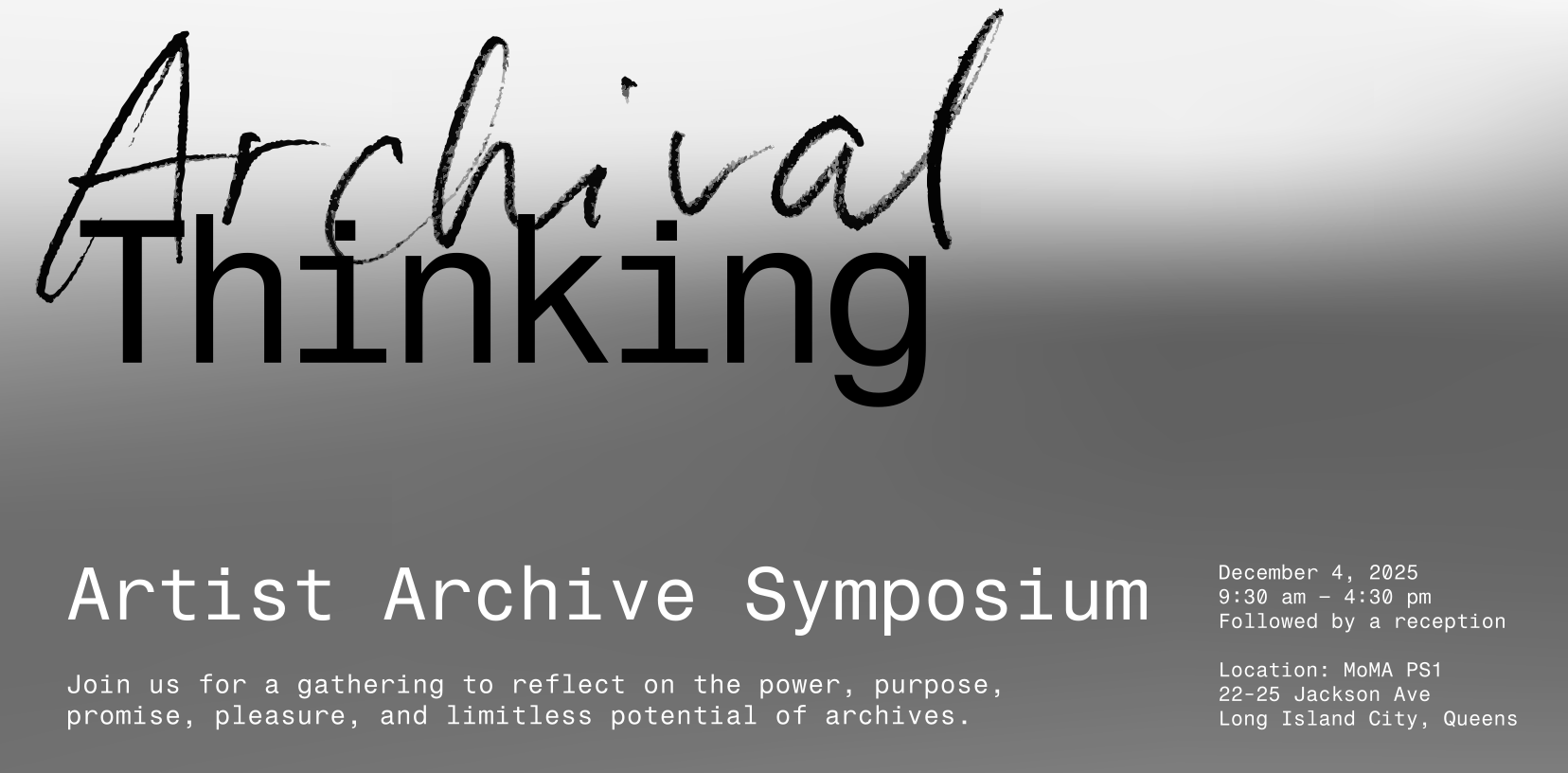
Archival Thinking: Artist Archive Symposium will be held on December 4, 2025, at MoMA PS1 in New York. Jointly organized by the Asian Cultural Council (ACC) and the Cai Foundation, with the support from the Rattray Kimura Foundation, the symposium will be curated and moderated by Paul Holdengräber. The event will take the form of a full-day forum bringing together distinguished speakers from the fields of art, archives, and the humanities to explore the contemporary significance and potential of artist archives, followed by a reception.
When an archive ceases to be a static repository and becomes a generative way of thinking, it records not only the past but also reveals unformed thoughts, emotions, and potential within the creative process. Many artists only begin building archives later in their careers to preserve their legacy — often resulting in fragmented narratives and gaps in memory. Archival Thinking: Artist Archive Symposium aims to encourage early-career artists, students, archivists, and cultural workers to explore the possibilities of archiving from the start — viewing archives as an integral part of creation rather than an afterthought limited to documentation.
The lineup of speakers spans across art, archival studies, literature and translation, and philosophy and intellectual history, including: Ross Benjamin (translator of The Diaries of Franz Kafka), Mel Yimeng Chu (archives manager of Cai Guo-Qiang Archive), Lisa Darms (former Executive Director of Hauser & Wirth Institute), Samantha Rose Hill (scholar of Hannah Arendt), Jennifer Wen Ma (interdisciplinary visual artist), Glenn Phillips (Chief Curator, Getty Research Institute), Rani Singh (Director, Harry Smith Archives), David Walker (Archivist, the Easton Foundation) and Martha Wilson (Founder, Franklin Furnace Archive).
Through keynote talks and roundtable discussions, the symposium will address questions such as: How do archives shape art history and contemporary art practice? What is the symbiotic relationship between art and archives? And how can archives evolve from ‘repositories of preservation’ into a ‘generative protocol’ in an era increasingly defined by the technological mediation of memory itself?
The seed for this symposium was planted thirty years ago when Cai Guo-Qiang, as a recipient of the Asian Cultural Council Fellowship, moved from Tokyo to New York for a pivotal residency at the P.S.1 Studio Program, which became his first studio in the United States. The move marked the beginning of his life and practice on the global stage — setting into motion a dialogue between art and archival practice that continues to this day. Building on that history, Archival Thinking transforms the archive itself into a new narrative center — one that fosters interdisciplinary dialogue and intergenerational collaboration. It invites artists, archivists, and curious learners alike to collectively redefine how knowledge is preserved, reimagined, and shared.
The symposium seeks to open the door for a new generation to discover the power, purpose, promise, and pleasure of archival practice. It reminds us that an archive is not merely a vessel of memory, but also a tool for action — a method through which each creator can help redefine the future of art.