Netflix's chart-topping adaptation of Shelby Van Pelt's bestselling novel features one of the most ambitious CG creatures in recent memory. We spoke with Untold Studios Senior VFX Supervisor Chris Ritvo about the challenge of bringing Marcellus the octopus to life.
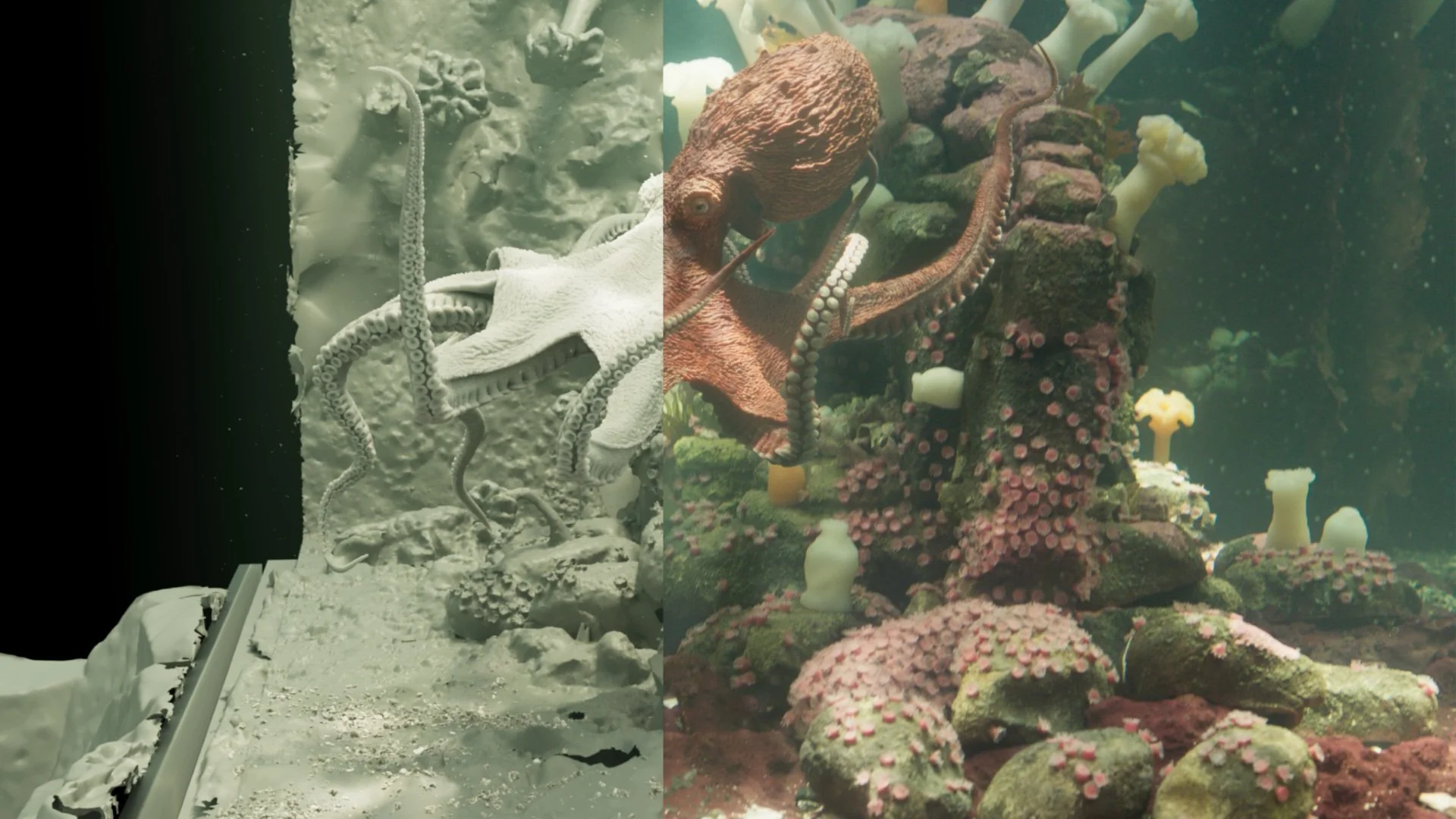
Netflix's Remarkably Bright Creatures has made a major splash, debuting at number one on the Netflix film charts following its release. Untold Studios partnered with Netflix and director Olivia Newman to bring Marcellus to life: the highly intelligent octopus at the heart of the anticipated screen adaptation of Shelby Van Pelt's bestselling novel.
Known for its award-winning creature and character work across film and advertising, Untold was brought on during early development to help define how Marcellus could be realised for screen. Senior VFX Supervisor Chris Ritvo led the work, reuniting with Newman following their collaboration on Where the Crawdads Sing.
"Before we even started prep, we spent around six months researching how we could bring Marcellus to life," said Director Olivia Newman. "We learned pretty quickly that there was no way to train an octopus to perform in the way the story required. So we knew the bar for our CG Marcellus had to be as photoreal as possible."
Head of Animation at Untold Studios Ross Burgess explains the nuances of building complex creatures:
"Octopuses are among the most complex creatures to recreate in VFX. Their soft-body anatomy, constant micro-movement, changing skin texture and colour, and highly dexterous arms make them a formidable CG challenge. Marcellus also needed to interact naturally with water, tank glass, props and live-action environments, often moving between underwater and above-water states within the same sequence."
Untold proved the approach with an early CG test, staging Marcellus hiding on a shelf in a scene from the script. The test gave the filmmakers confidence that the character could be built digitally, with the realism and performance range needed for the story.
For Ritvo, however, the scale of the challenge became immediately clear when he met the real octopus that inspired the character.
DAB: What were the earliest conversations with director Olivia Newman about what Marcellus should feel like on screen?
CR: Livi Newman shared the script with me quite early in the process, before Netflix had greenlit the film. She wanted to discuss options for featuring an octopus — even the possibility of shooting one for real. We decided pretty early on that a digital octopus would give us the most creative freedom, from set design and building our own practical tank and to be able to direct Marcellus as one of the main characters in the story. Livi's direction was always that she wanted to be able to cut between Agnetha — the real GPO we based Marcellus on — and our digital one, which was a big ask!
Building One of VFX's Most Complex Creatures
"Marcellus was built as a complete performance asset rather than a shot-specific solution. His look development was designed around the adaptability of a real octopus, with multiple pattern, texture and camouflage states that could be blended across scenes. The model included more than 270 suckers per tentacle across eight arms, supported by layers of rigging that allowed animators to shape both broad performance and highly specific sucker and contact behaviour," said Chris Ritvo.
On set, production used a puppet matched to Marcellus' color, scale and texture, giving the filmmakers and VFX team practical lighting reference while preserving the flexibility of a fully CG performance in post.
"When you look at a real octopus, everything is moving all the time, in every direction," said Ritvo. "Our CFX team created the skin and tentacle movement that really made Marcellus come alive underwater."
The character also required extensive CFX work to capture the constant motion of an octopus' skin, arms and suckers. Untold developed simulation passes for tentacle movement, skin detail, environmental contact and underwater behaviour, giving Marcellus the tactile, living quality needed for Newman's adaptation.
What was the hardest aspect of recreating an octopus digitally?
There really was no easy part of creating a digital octopus. When I first visited Agnetha, the resident Great Pacific Octopus at the Vancouver Aquarium, it's quite a humbling experience to see her up close. They are extraordinary animals, almost unbelievable to watch. What I first noticed was that everything was constantly moving, changing — not just her tentacles, but the skin itself, which behaved like cloth, influenced by both her movements and the natural current of the tank. Then when you see the suckers make contact with the glass of her tank or the environment around her, you realize just how intricate and dense the detail and movement is, and there are eight tentacles of that! This level of detail required an immense amount of work in building the asset and modeling all of that complexity. Animation required a very dense rig with multiple levels of detail to recreate that kind of movement, with Marcellus's skin needing to move under simulation while also controlling the suckers. It was definitely one of the most complicated assets I've been a part of.
A Studio-Wide Collaboration
The work builds on Untold Studios' previous creature experience, including award-winning Blub Blub for Disney and Octo for BMW's Heart of Joy. That foundation gave the team a head start in rigging and look development, while allowing Marcellus to push further in realism, nuance and character performance.
Creating a creature this sophisticated required close collaboration across nearly every department at the studio.
What did collaboration between departments look like on a creature this technically layered?
As I mentioned, each department had to inform the next — working hand in hand, passing work back and forth to make sure everything came together. Layout and environments worked very closely with lighting to render the refraction that we see in the real tank glass, this often required bespoke modeled geometry to be exchanged shot by shot. Animation and Creature FX had to coordinate closely as well: animation delivered keyframed movement, then Creature FX would take over, adding more flop, skin movement, and sucker animation before handing off to FX to simulate water splashes, particulate, plant interactions — everything Marcellus touches. Compositing and lighting collaborated extensively too, since Marcellus's look varied significantly across scenes, and the lighting passes needed to give compositing the control to manage his colors and wetness levels. Every department informed the others and vice versa — a true collaboration.
Which small detail in the final film are you especially proud of that viewers may never consciously notice?
In one shot, we see Marcellus travelling back to his den carrying a green dinosaur toy — a nod to the novel, where he's been collecting trinkets from around the aquarium on his outings. He also pushes over a paperclip in the same shot!
Marcellus also appears beyond the film itself, featuring in the wider launch campaign for Remarkably Bright Creatures, including the new film tie-in edition of Van Pelt's novel and a Times Square billboard.
Looking Ahead
As visual effects tools continue to evolve, AI has become an increasingly common topic throughout the industry. For Ritvo, however, creature work like Marcellus remains firmly rooted in traditional artistry and technical craft.
Has AI or machine learning begun influencing CG creature workflows in meaningful ways yet?
AI still feels like it's at the beginning of its arc, which doesn't mean it isn't coming. No AI was used on this project, but the influences we're starting to see in the industry are mainly in concept work and pre-vis. It's now possible to get very high-quality pre-vis with relatively little overhead on lookdev and asset building, which means filmmakers can temp their movie more quickly and get a clearer sense of the final look without the longer wait times traditionally associated with that quality level. For final-frame render quality, AI still seems to be some ways off — but it's always growing, and hopefully it will take on some of the more time-consuming tasks and free artists up to focus on the creative work.
We share works by digital artists as well as digital arts exhibitions, events, and open calls daily on Instagram — follow us for more and subscribe to our newsletter so you don’t miss new blog posts.
![Project Spotlight: pifmgr.dll’s [M]ETAL✨ @pifmgr.dll is a digital artist working at the intersection of audiovisual design, 3D experimentation, and atmospheric world-building. His project [M]ETAL explores metal both as a physical material and a](https://images.squarespace-cdn.com/content/v1/63b2fdbe4376de5bfdc6771f/1779108338452-QO04Q3MMJ3VMU8PJV1MD/image-asset.jpeg)