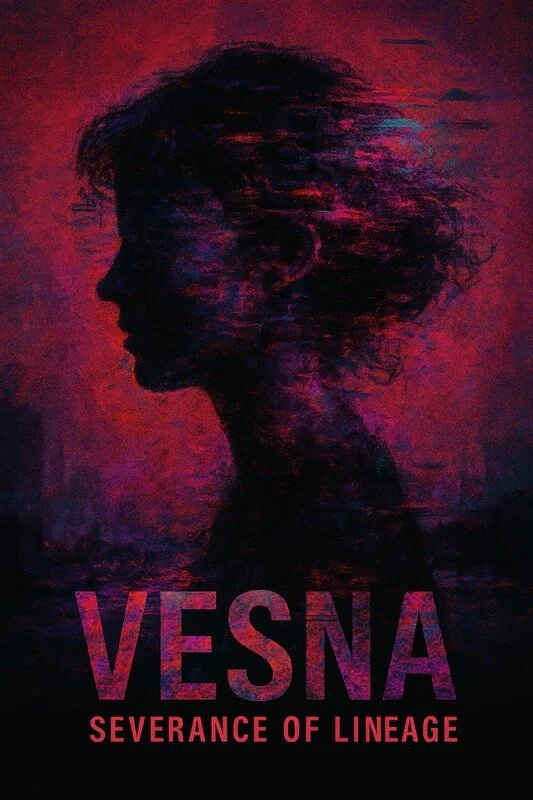
Vesna: A Generative AI Film About Resistance in a Dystopian Future
By Cansu Waldron
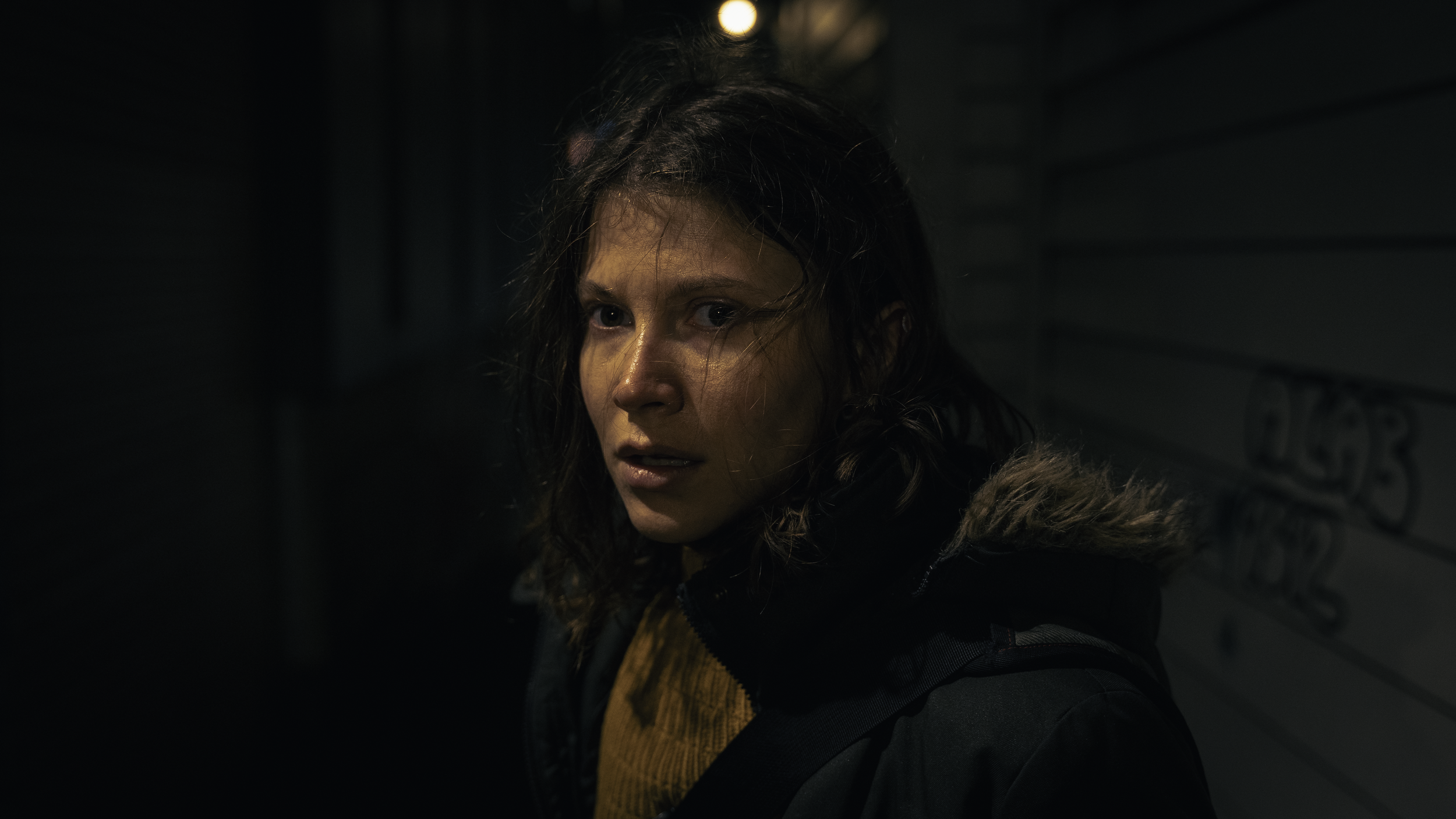
Vesna is a generative AI film by creative duo Kate Ryan Brewer and Cody Gallo, set in the year 2056 after a global nuclear conflict. The story unfolds in a fractured Norway, where Oslo has been destroyed and cities like Bergen continue to function amid constant instability and shifting control.
The film follows Tiril, a former baker turned war synthographer, who uses her self-built AI system, Titian NG, to document the stories of resistance fighters while protecting their identities from the regimes pursuing them. Operating between digital memory and deliberate erasure, her AI creations become both record and creative force, preserving stories that might otherwise disappear while pushing back against occupation and control.
Below, I chat with Kate and Cody about building a generative AI film as a transmedia project, their collaborative process, and inspirations.
What first sparked the idea for Vesna? Was there a moment or image that made you both feel, “This has to be a film”?
CODY: So what first sparked the idea for Vesna? Well, it comes from a feature film script that Kate and I have been developing for a number of years, House of Saturn. In that script, there's a character that has this throwaway line where they refer back to a historical event, the Vesna Revolution. We've been working on this world and developing the story for a while, and this was on my mind when I was doing this AI filmmaking residency back in 2023 called <Story&Code>.
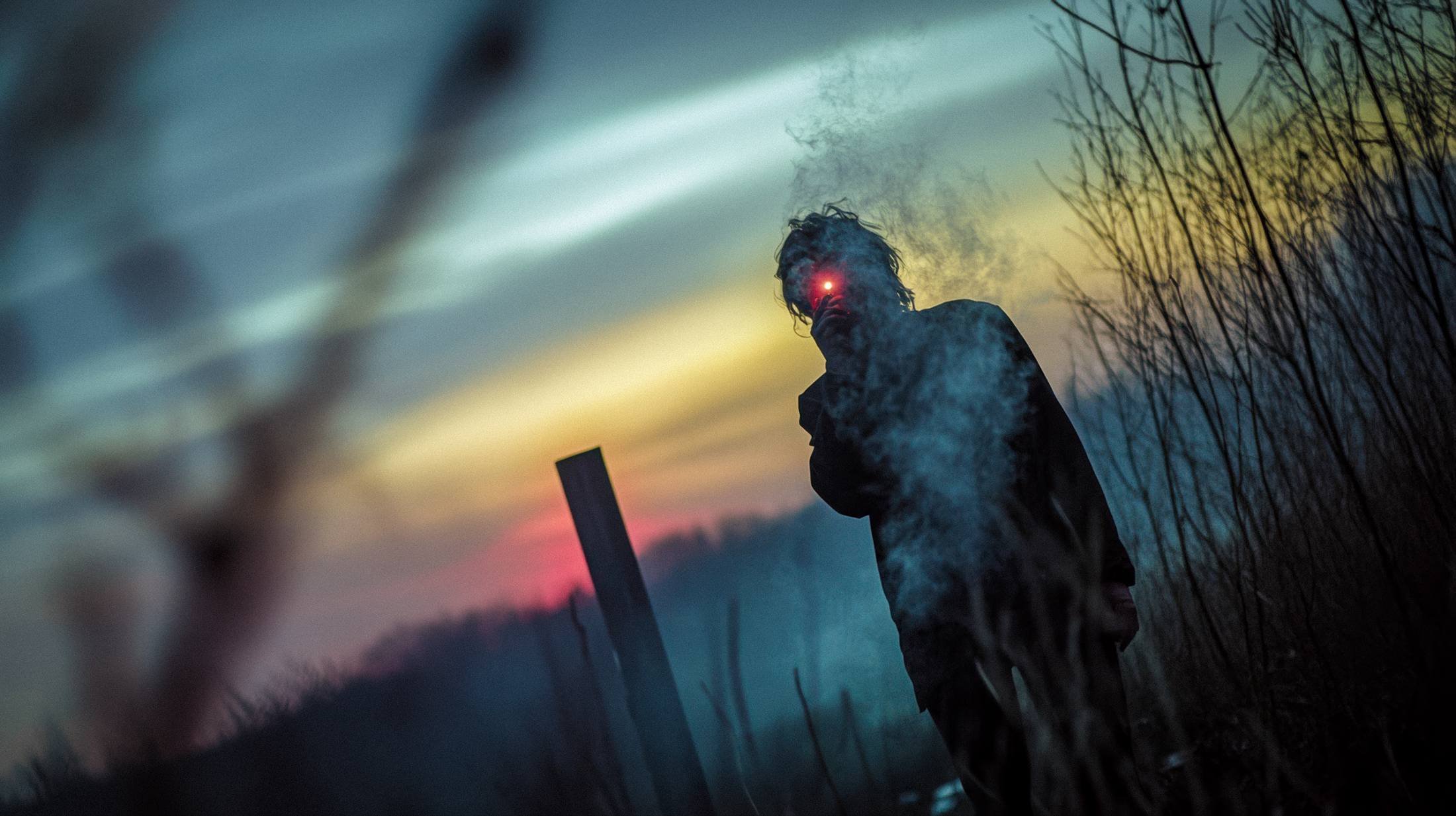
During the residency, I was experimenting a lot with Midjourney. I first had the idea that I wanted to develop a specific style for a specific story, kind of like choosing a film stock or developing a LUT as you would in filmmaking. I just needed a subject to experiment with, and I thought, well, what's this Vesna revolution? What happened then? What would it look like?
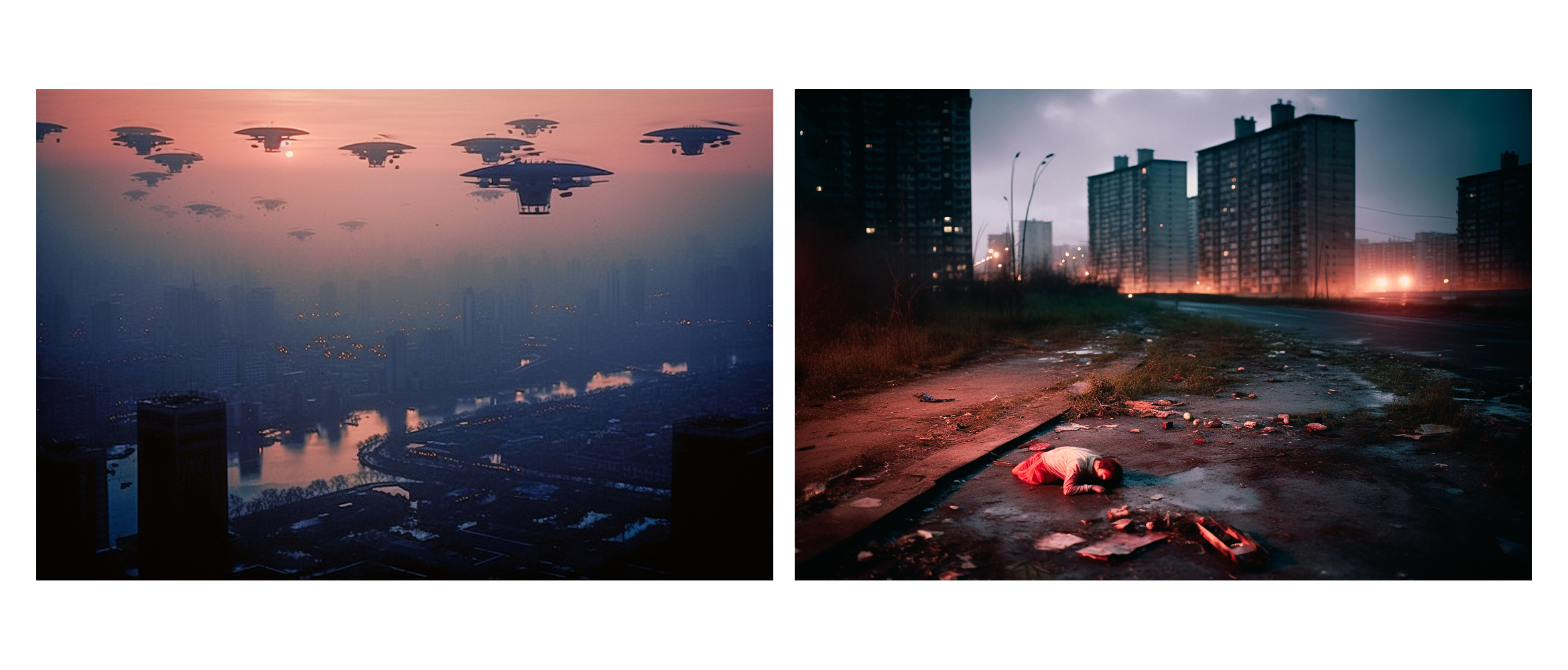
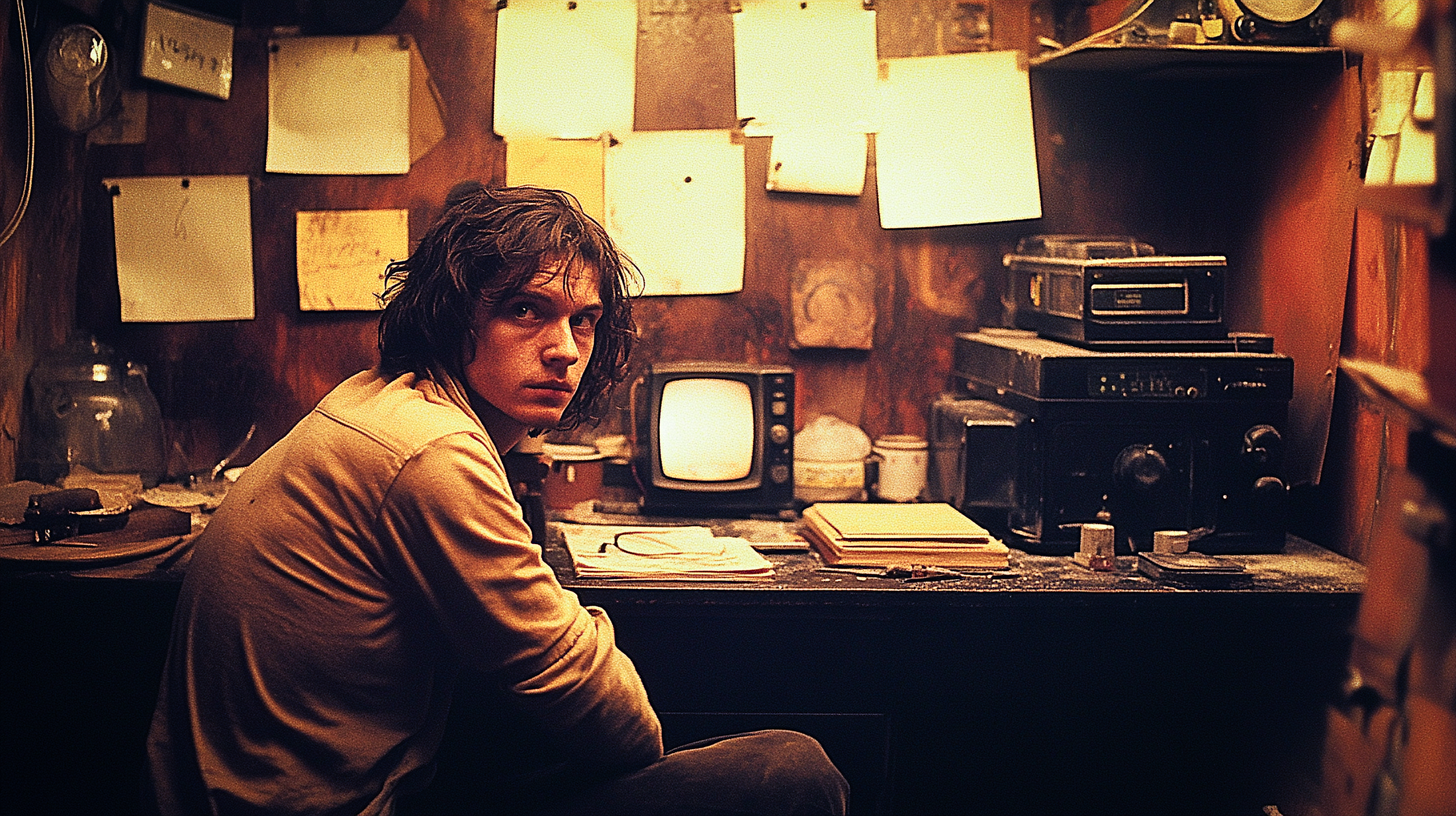
There was no story, but I was thinking about what the synthography might be at that time—maybe there'd be these devices or cameras recovered—and what would those images look like if it had been an atomic war, or just the fallout of all that, and images were being recovered? Would it be radiation damage or light leaks? I was just experimenting with a bunch of styles to try and create a specific style, more than a specific subject.
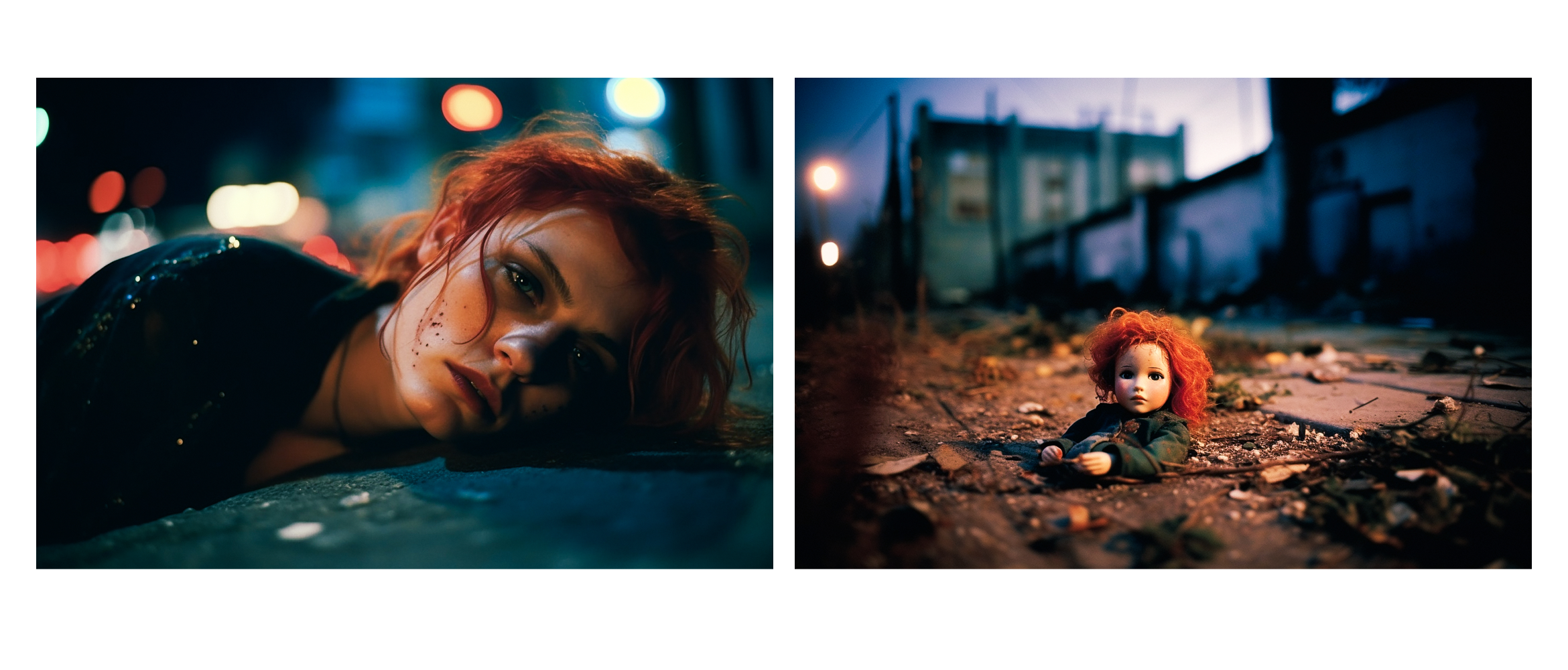
In that process, I needed a subject to test on, so I started with the image of a dog in a ruined city. Then I started prompting a broken doll lying on the ground—this idea of just something that got abandoned in an evacuation. The interesting thing that happened with Midjourney was that in each batch of four images, I wouldn't just get these broken dolls, I would get an image of a woman, this red-headed woman, lying on the ground, a bit battered and bruised.
One of these images intrigued me, and I sent that to Kate. I said, I don't know who this character is, but do you want to write something for this?
KATE: I love that the idea for Vesna was built from both a world already conceptualized in House of Saturn (albeit not in as much detail) and a world almost creating itself within Cody’s evolving synthography. And even though it was written well before a number of significant international events, it had the feeling of being something timely and urgent.
When Cody showed me the imagery of the woman who became the character we call Tiril, it felt like it needed to be a story centered on her. To focus on one experience in a challenging environment. It’s so easy for the humanity of a crisis to get lost amongst statistics, or even the mundanity of day-to-day living. The image of the woman felt like it was calling out like a strange deja vu.
How did you approach making a story with generative AI? What parts of the process felt familiar, and what felt completely new?
KATE: For me it was the process overall that felt quite new. The components were familiar in that you have story or dialogue, writing, sound design, imagery, music, etc. Traditionally there’s a pretty standard order of events. This process was all over the place.
That’s not to say it wasn’t organized, it was highly organized. We had to be, especially with how many images we needed to generate and how they needed to be specific yet cohesive to the story as a whole. But it was exciting to create a film where sometimes an image will create an idea for a rewrite of a line, or a sample of the score might inspire a different sort of prompt.
Instead of there being a strict order, it was as if - past a certain point - it had a very organic way of one element or aspect of the creation feeding into another. So although the individual components were familiar, the way it came together was different and invigorating. It kept you on your toes.
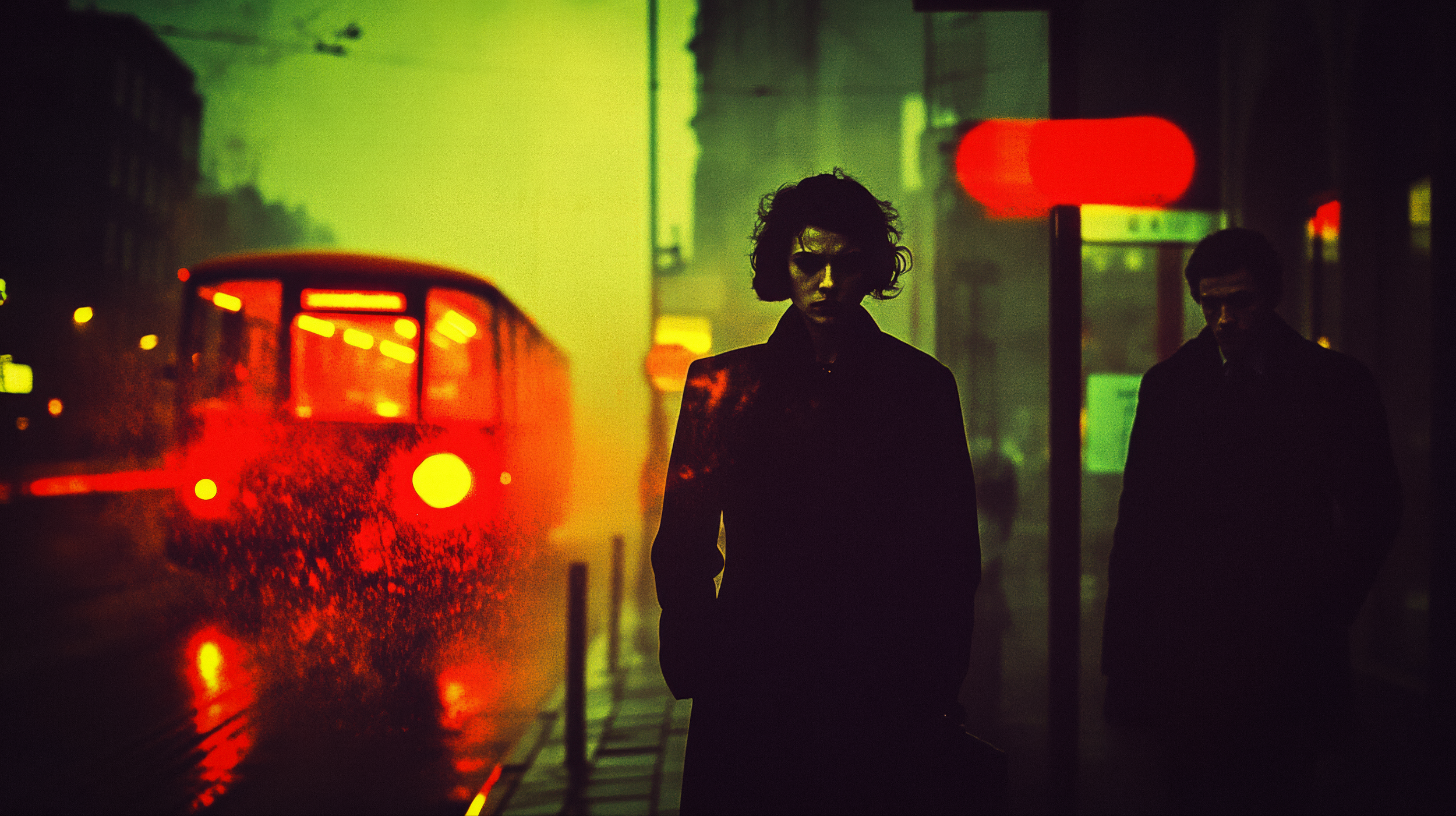
CODY: I would say that our approach in making this story started through this interaction with the generative AI. Although it really started with this original story that had nothing to do with generative AI, which Kate had written. And then feeding that seed of an idea into the generative AI, we got inspired for this new character and storyline.
At that point though, we stepped back and Kate just sat down and wrote the script, and then she sent me a draft, which I responded to. I thought it was really great script material, and we did some rounds of revisions. But then it really was starting from the story being written by a human. And then we were going through some revisions, and the project was gestating for a little while as we did other things and kept experimenting with the imagery.
And then at that point, there was a little back and forth because we had the script, then we were still revising it a bit, but then I was getting inspired by the writing, and I was generating more images and I would send some images to Kate and I would say well what about these characters, who are they and what their story.
So, also back to the <Story&Code> filmmaking residency, a big part of that was having us reflect on the process of working with Gen AI. How does it feel as an author and creator? When do you feel you're in control? And when do you feel like you're maybe losing control? Or where do you want to let go of control?
And I think that's part of the Gen AI, is when you really try to control it, you really struggle with it. And when you're looser with it, you can get some more interesting results, but then you have to be open to the fact that it's coming from the gen AI in that respect and less from you. And so then it's this idea that this is more co-creating or AI-assisted, these different terms that are being developed.
As a writer/director and a synthographer, how do your roles complement each other when building a world like Vesna?
CODY: So I would say, as a collaboration between Kate as the writer and director and myself as a synthographer, the ways in which our roles complemented each other start first that we have a creative working relationship from other projects over the past couple of years that we're building on.
But for me personally, I'm generating images and living in this Vesna world, trying to build THE world through the generated images. Kate would make a shot list for various scenes. The story's made up of these journal entries of the main character, these kind of voice journals. Then Kate would make these shot lists and we would attempt to generate those shots, but I tell people it's more like documentary filmmaking, where you're generating a lot of b-roll and then you're going through and curating and selecting shots.
Yeah, so I'd go about that from the synthography side of generating images. I'd have her intent, the kind of vision that Kate had, and I would take that into the generation process. For me, it's creative, and it's invigorating to work with these images, but then it can also be exhausting and you're kind of pushing with the system, trying to get a certain look and then it's not doing what you want and you just realize, I really have to step away.
Then Kate and I would have these calls and look at the image together, and we'd get inspired. It would be this kind of new perspective that she would bring in, looking at the images and looking at what I was trying to prompt for and coming up with a new idea that would keep the energy up.
There was a funny moment when Kate asked for a shot of a toothbrush on a bathroom sink, and we realized that Midjourney did not know what a toothbrush was and could not generate one to save its life. Now, the generators are so much better, it wouldn’t be a problem, but back then, we had to abandon the shot of a toothbrush.
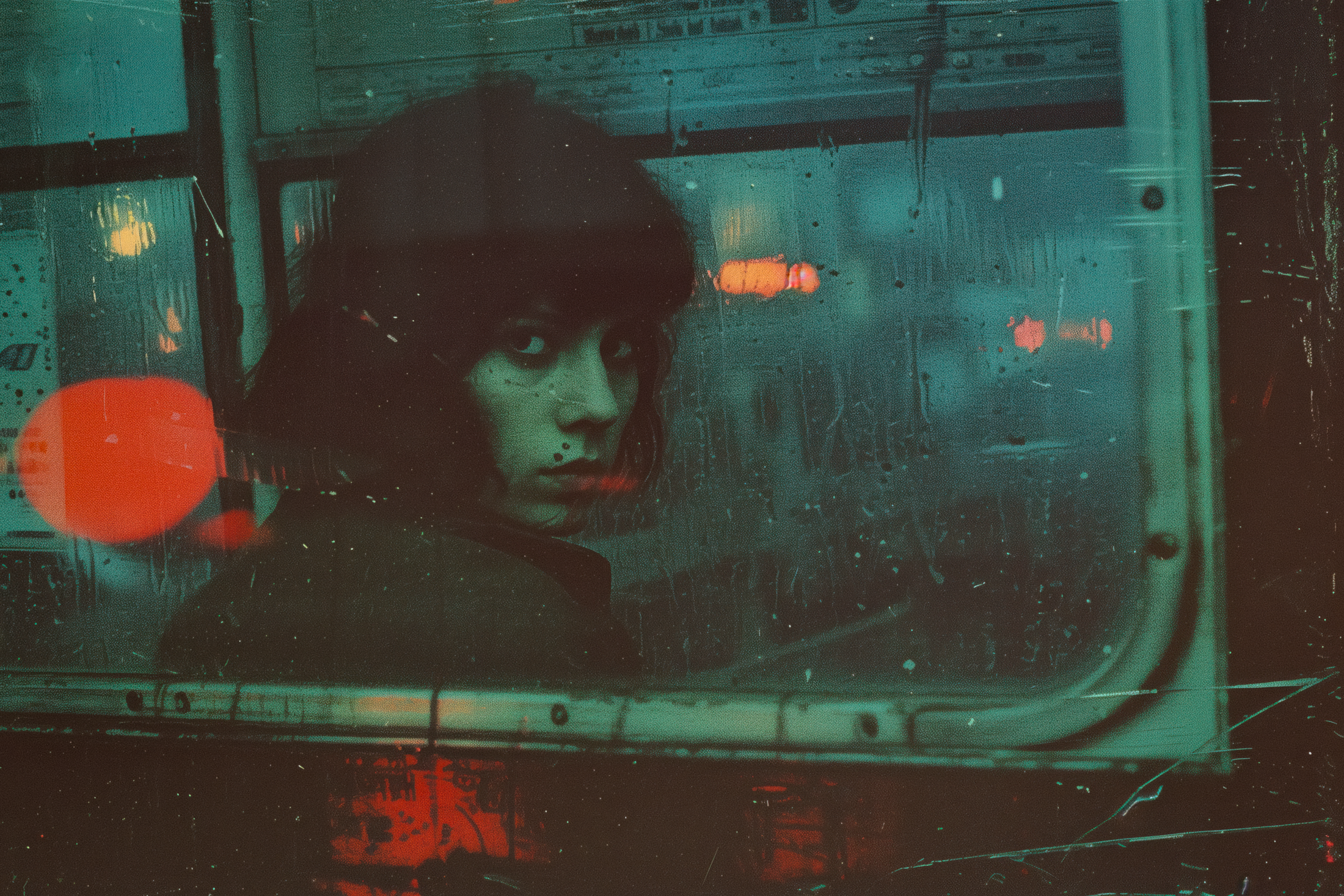
KATE: I think Cody said it all very well, and it helps that we already have a creative repertoire. But I also think that these roles complemented each other especially well in this format.
This can be an extremely flexible format, which means ideas that either of you may have at any point in the process can reverberate throughout the story from beginning to end. Even if you’re already almost at “the end.” We were still generating new ideas and imagery when the edit was almost finished. I know re-shoots are a reality in film but they tend to be a last resort for obvious budget and time constraint reasons.
I feel like this aspect of the process kept both of us asking questions and pushing the story forward together in a highly collaborative way. We had a lot of insight into each other’s decision-making for any given moment.
What were the biggest discoveries or surprises while creating the film? Either creatively, technically, or emotionally?
KATE: I think one of the most surprising aspects of making Vesna was how instinctual it was. I’m not referring to the image prompting per se, as Cody was the one managing Midjourney and there was a lot of trial and error in there, time spent exploring, and experimenting of course.
What surprised me is when we needed to make a decision on what image to use (or even what to prompt, sometimes), it came down to “how does this feel?”
He would pull up four or eight images that technically fit the description of what we needed, but often there was something on an instinctual level that just fell flat. And then other times one image would jump out at us, give us a certain gut-level reaction. That was always the image that felt right to follow, regardless of what was in the script or what we’d written in the shot list.
I likened the experience to the TV Show Severance (no spoilers, I promise) - “do the numbers feel scary?”
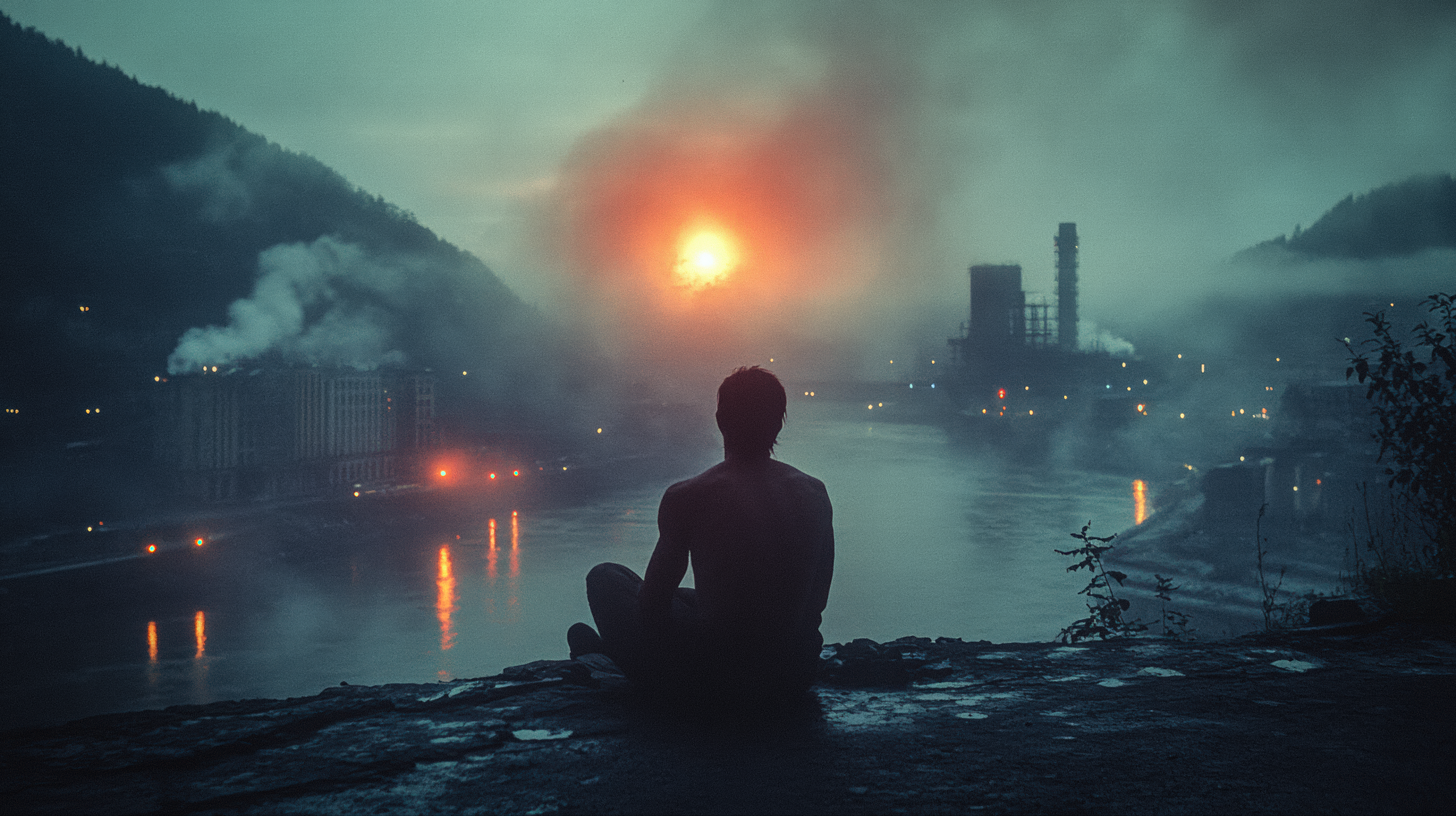
CODY: I'd say, as far as biggest discoveries or a surprise while creating this, from a creative or technical standpoint, in the synthography of it and working with Midjourney, I stumbled into this interesting technique where, because I would generate so many images and then I would scan through them with my arrow keys. And then sometimes, when I would generate many remixes or variations of one image, I would see that it would almost start to animate and look like an abstract animated piece. And so that was just a real discovery that we then incorporated in the piece. And you can see in certain entries–the end of episode 4 is a good example, when the hands are kneading dough. Tiril is reciting her mantra of a recipe when bombs start falling, so it becomes a visual metaphor for her mental instability and trying to hold on in that moment, to stay grounded.
What I would end up doing is creating an image, and then, with this remix feature in Midjourney, I would also inject noise back into the image. To do it, I would screenshot an image as it was forming in Midjourney. When it was still at around 33% generated, it still looked like a very noisy image, which is part of the technical process of generative AI forming out of noise. I would take the screenshot of the noise of the image, and then in the remix, I could inject that as an image prompt back in, and I would push the image back into this abstraction of noise. I would do it over many generations and create a folder with a couple of hundred images, and then when you step through rapidly with the arrow keys, it would animate. I found if I did this to music and I could actually then just screen record it live as I stepped through the images to the music. You can see this on the Instagram account as well. I did some standalone video pieces of music and animation, and some of those actually are what audiences have already responded to the most as really just beautiful abstract pieces, so that was quite a discovery for me.
How does Vesna extend beyond the film into the larger transmedia project? What other pieces of the story world are you developing?
CODY: So this Vesna short film extends beyond this film, and it is part of a larger transmedia project. Of course, as we said earlier, it came first from this feature film screenplay, which we still plan to produce as a traditional live-action filmed sci-fi narrative. So it relates to that world, but then as we came up with the idea for the Vesna film, we created it as a standalone short film, but then also we saw it as these individual entries which are being released now online through Instagram, and that Instagram channel, called @Titian_NG, is actually the name of the AI model in the story.
And so, we saw this account as the voice of Titian_NG, the AI model, trying to actually recover the story of Tiril from its archives. So we have the short film, and we have the Instagram feed, and this all feeds into the kind of bigger world of the feature film screenplay that we'll produce, House of Saturn. And yeah, there's other stuff coming out of it. We envision that aspects of this project we'd love to see curated in a gallery, making it a physical interactive space where some of the images and video clips are shown, displayed in a gallery setting. As a kind of retrospective of the character Tiril, who's a self-styled war synthographer, in that her images would actually be curated as an exhibit.
KATE: The other aspect of this transmedia project that’s really exciting is that it has reverberations throughout this world that we’re creating. For example there are aspects of the feature script, House of Saturn, that are now influenced by Vesna. It feels quite symbiotic.
What do you hope audiences feel or take away after experiencing Vesna?
KATE: I hope people come away feeling at least a little uncomfortable, honestly. We are at what feels like a critical time in history on so many fronts, and with a flood of information (and misinformation) it’s difficult sometimes to stay healthily engaged.
We hope this can be an entry point to asking challenging questions - about the ethics of AI as a creative tool, as a tool in general, about forms of resistance. And about how to preserve agency and humanity in a world where they can be under threat.
CODY: So there are a couple of things that we hoped audiences would feel or take away after the experience of the Vesna project. I think first and foremost, from the story perspective, it was an experiment in itself to say, will audiences feel anything or empathize with synthetic characters? Vesna is an open question to the filmmaking community at large: if we're going to use AI tools in creating stories, will audiences connect with synthetic images?
That was the first experiment, but then, in writing the story, Kate channeled a lot of different things into it about war and occupation, and resistance. So I think just from a story standpoint, we hope audiences will relate to that feeling of being swept up in events in the world that are out of your control, which has kind of been what a lot of us have gone through the last couple of years. How do you retain any agency in these world-shifting events?
And then there's another level, which we hope, as we put this out more in the filmmaking community, from the behind-the-scenes aspect, that it gets discussed from the standpoint of using AI tools in film, how do we want to use them? How should they be used? Where do audiences accept it or not accept it? And again, that's an open question that we look forward to seeing how people respond.
Production Notes (CODY): I just want to add some additional notes about the production. It started with Kate and me, with her writing and directing and me generating images. But then we decided early on that we did not want to use an AI voice. So we recruited the actress Eili Harboe, a Norwegian actress who is really good, and I had known from a previous project. She is the lead in Joachim Trier’s film Thelma and was in the last season of Succession. We asked her to do the voiceover for Tiril. And then after recording all of that voiceover in studio, we really got into the main generation process for each entry.
And then we wanted to bring on board our friend, Tim Driscoll, as a producer and editor to start editing the entries together. We experimented a bit with some AI music, but we quickly decided that it wasn't cutting it for us. And so Kate reached out to someone she had met through a Catalyst program in Germany, David Eamon Tighe, he then came on board as a composer and it was a great collaboration where he would look at the entries, listen to the voiceover, look at the image we were generating, and then he would start composing pieces of music for the individual entries. So he created the soundtrack, which is also out on Bandcamp.
That was the main collaborative process. And then you'll see, without any big spoilers, as you get to the very end of the piece, we've generated all these images. But then we did a still photo shoot with the actor, Eili, playing Tiril. And there's a transition at the very end of the film from synthetic images to real images taken on the streets of Bergen. And I'll leave you with that.
In closing, we would like to reiterate that the film as a series is being released in 20 parts on Instagram first through the channel @Titian_NG, now through February. The 30-minute short film as a whole is in submission to multiple film festivals, but we would love to hear from people who want to curate it. We are also inviting people to host private screenings and use the film as a conversation starter about communities of resistance or AI in filmmaking. They can contact us at vesna@cnma.tv.
Kate Ryan Brewer, Writer / Director
Born in Seattle and raised in Southeast Asia, Kate is an independent writer and director. Her first feature film, “Knots: A Forced Marriage Story,” is an award-winning documentary about forced and child marriage in the U.S. It’s also the subject of her TEDx Talk.She is also a published author, short story writer, and essayist, and has collaborated on several art and media projects, including performing a written piece for WordTheatre in London. She graduated from Florida State University Film School, and completed an intensive acting-for-film course at the Catalyst Institute in Berlin. She has lived and worked around the world.
Cody Gallo, Synthographer
Cody Gallo is a DGA Assistant Director active in the industry since 2010. During that time, he has worked with a range of auteur directors from David Lynch to Gunnar Vikene. His AD credits include Twin Peaks: The Return, A Star is Born, American Horror Story, and The War Sailor. Born and raised in Decatur, GA; he attended Florida State University on an ROTC scholarship where he received a B.F.A in Motion Picture, Television and the Recording Arts. He was accepted into the Directors Guild of America - Trainee Program (LA) in 2013, and he completed the program in 2016. He now lives and works in Bergen, Norway with his family.
Director Statement
“This is a deeply human story of memory and resistance. Tiril’s journey is one of a “normal” person in “extraordinary” circumstances. Circumstances that are, unfortunately, all too familiar today: war, misinformation, bearing witness. Tiril starts as a baker and ends up becoming a revolutionary. She goes from a profession that is ancient and earthy to building her own AI image-generating algorithm that she names “Titian NG.” I was fascinated by that trajectory. It contains subtlety. There’s a powerful blend of grief, practicality, and the desire to hold onto identity at all costs. A delicate dance between hope and resignation. Knowing that history is written by the victors, how do the oppressed fight back?
Structurally, using stills with voice-over instead of moving images presents its own unique challenge. While most short films have a standard process from start to finish, the nature of this collaboration blurs those lines. For example, Norwegian actress Eili Harboe brings Tiril to life. The way she inhabits Tiril in her body and her voice will inform the images we develop, since we won’t be watching her onscreen. There are times the imagery closely reflects the story Tiril is telling, and other times the imagery will be abstract. The imagery and sound design inform each other in a similar fashion. I find the tension in those decisions exhilarating.”
We share works by digital artists as well as digital arts exhibitions, events, and open calls daily on Instagram — follow us for more and subscribe to our newsletter so you don’t miss new blog posts.
![Project Spotlight: pifmgr.dll’s [M]ETAL✨ @pifmgr.dll is a digital artist working at the intersection of audiovisual design, 3D experimentation, and atmospheric world-building. His project [M]ETAL explores metal both as a physical material and a](https://images.squarespace-cdn.com/content/v1/63b2fdbe4376de5bfdc6771f/1779108338452-QO04Q3MMJ3VMU8PJV1MD/image-asset.jpeg)