Kadu Tapuyá: The Indigenous Future Was Already Here
By Victor Murari
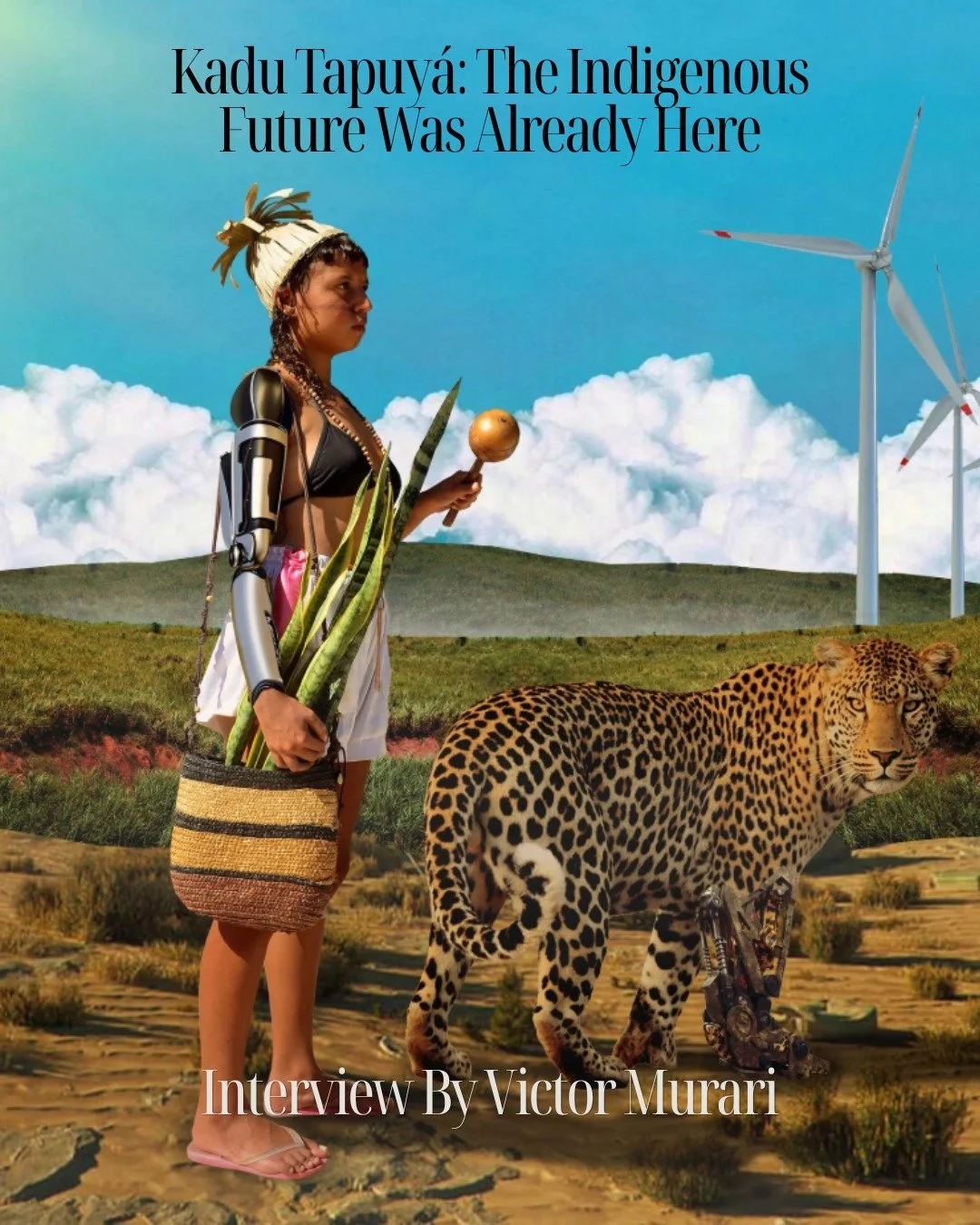
Kadu Tapuyá’s production intervenes in a sensitive point of Brazilian contemporary art: the persistence of colonial images that still condition the reception of Indigenous peoples within the cultural field. His work breaks with the expectation, still present in cultural institutions and international circuits, that Indigenous identity should remain tied to originary purity, territorial isolation, or a fixed image of the past. His production in digital collage is marked by cybernetic prostheses, post-apocalyptic imaginaries, and references to Indigenous Futurism. This visual vocabulary shifts the viewer’s gaze toward a more complex temporality, in which colonialism no longer appears as a closed episode. It comes to be understood as a historical violence that remains active, capable of organizing territories, images, infrastructures, and forms of recognition.
His images reject the figure of the Indigenous person as an ethnographic remnant and affirm a contemporary, urban, technological, and politically situated subject, able to dispute the visual codes that have historically reduced Indigenous peoples to caricature or exoticism. In series such as Indígenas Favelados and in works such as Tapuya Abaporu, the critical appropriation of modernist, cyberpunk, and media repertoires functions as an intervention in the grammar of Brazilian art, exposing the limits of a canon that has frequently incorporated the Indigenous body as an aesthetic sign without recognizing its historical agency. To know artists such as Kadu Tapuyá, in a decolonial context, means understanding that the transformation of the artistic field cannot be resolved through the simple inclusion of new names into old structures of legitimation. It requires attention to practices that reformulate the relation between image, territory, memory, and future, placing in crisis the ways in which museums, markets, and national narratives continue to administer the visibility of Indigenous peoples.
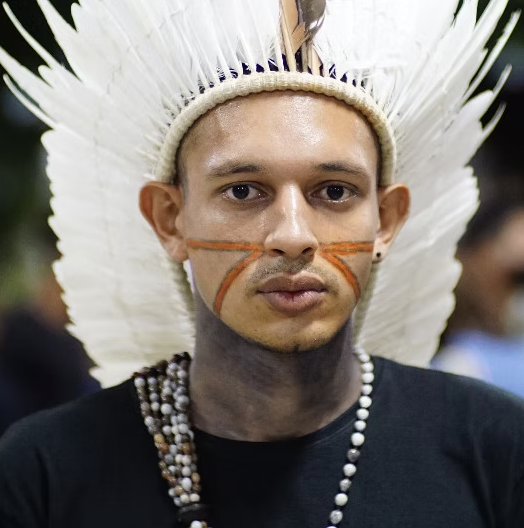
For audiences outside Brazil, the image of the Brazilian Indigenous person is often and mistakenly restricted to the isolated figure in the Amazon rainforest. You are an artist from the Marikito Tapuyá ethnic group, from northeastern Brazil, a region marked by centuries of colonial violence and monoculture, and you use digital collage as your main medium. How does the choice of digital manipulation and cybernetic networks, rather than the traditional physical artifacts expected by foreign curators, work as a tactic to dismantle the stereotype of the “pure native” and place your contemporary identity at the center of the global artistic debate?
The futuristic aesthetic associated with the image of the Indigenous being has an impact on foreign audiences as well as on non-Indigenous Brazilians. We are bodies associated with the past, trapped in an imaginary of extinction, so recreating these images represented in the future, or even in the contemporary, creates a noise in the preconceived notions people have, mainly because we are peoples whose history was hidden and written from the mistaken perspective of the colonizer. So I think my work is also a way of writing current history, especially because our notions of the future are tied to our present. No one actually knows what it will be like, we project it. And I hope that, in the future, my collages may serve as a source for analyzing and celebrating the temporality we are living in now.
Indigenous Futurism has theoretical roots in North America, but the Latin American context carries specific colonial traumas. In your work, the apocalypse is not a speculative dystopia for the future, but a real event that began in the fifteenth century with the European invasion. By incorporating cybernetic prostheses and post-apocalyptic settings into your series “Indígenas Favelados,” how do you ensure that these visual codes of Western science fiction communicate the urban ethnogenesis and real survival of your people, while avoiding having the work consumed merely as technological exoticism by the international market?
I cannot guarantee that my work can guarantee anyone’s survival, but I am satisfied with the criticism and reflection it generates, and when it manages to bring a little hope when thinking about our futures, even better. The cybernetic perspective arrives in a very convergent way in “urban ethnogeneses,” because today’s Indigenous people are also the result of the whole process of industrialization and globalization the world has gone through. Beyond the imaginary we carry ourselves, we have the worldviews of our peoples, but we have also been fed by Hollywood for years, so there is no barrier between “the visual codes of Western science fiction” and the audience being represented.
North American cinema acts as an important imperialist tool, homogenizing a model of life, presenting through cinema the future proposals they have for the world, like a TikTok ad. Many Indigenous people feel more represented by futuristic glasses and jetpacks than by our representations over the last 500 years, made by Europeans who saw us as animals. And as for cultural exoticism coming from foreigners, there is nothing I can do about that. It says more about them than about my work. Maybe they need therapy.
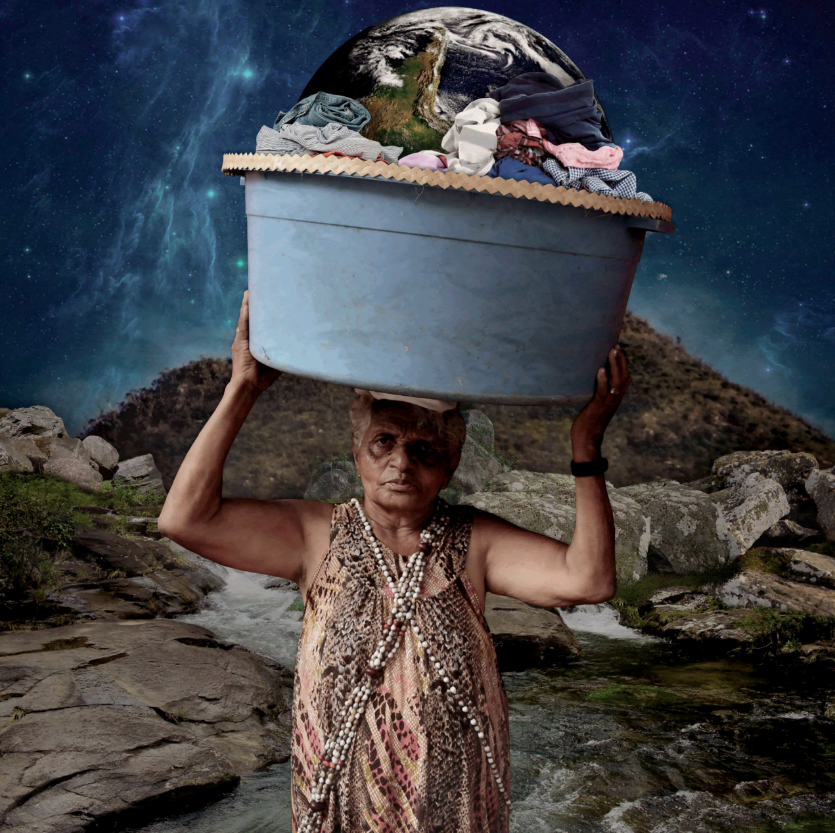
Your series “Indígenas Favelados” destroys the twentieth-century state indigenist narrative according to which forced migration to the metropolis results in the “acculturation” and death of the Indigenous subject, repositioning the favela as a technological trench of living resistance. In what way do the cyberpunk aesthetic and the cybernetic prostheses present in these collages help articulate this metropolitan survival without your work falling into the trap of hi-tech exoticism in the eyes of the European art market?
I think it is important to stress that I cannot carry the burden of associating my work with the survival of several groups. I believe art has the power to project many things. Through my work, I try to project futures, illustrate paths we might follow, and criticize the routes the world is taking, from my point of view.
I have already done some work in Europe and the United States, with exhibitions in festivals, museums, and universities. When my work is in these spaces, I cannot take responsibility for the gaze of the other. What I hope is that, in some way, we can reap the fruits of its circulation here, representing the Indigenous peoples of the Northeast and making visible and strengthening the process of reclaiming my people’s lands. As well as contributing to my own survival as an artist.
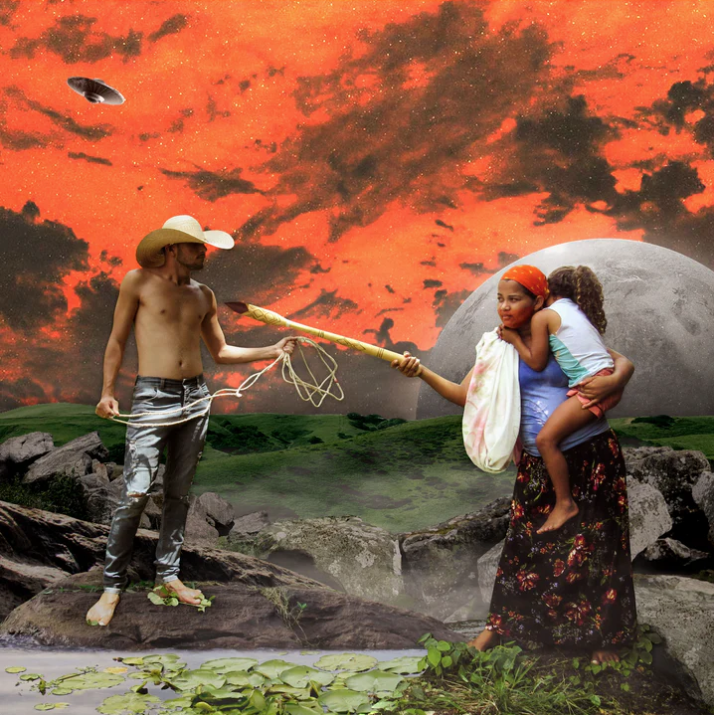
Your work “Tapuya Abaporu” (2022) carried out what we call an “Anthropophagy of Re-volt” by devouring and remixing Tarsila do Amaral’s greatest icon, exposing the fetishization and erasure of the native body promoted by a white elite. Considering that Brazilian art institutions are still structurally dependent on the modernist canon of the Week of 1922, to what extent is the hacker insertion of the contemporary Indigenous subject into these classic paintings enough to actually decolonize museum collections and mentalities?
The work “Tapuya Abaporu,” a reinterpretation of Tarsila do Amaral’s painting, I believe it is important to stress that I have a strong critique regarding the reinterpretation of this work. However, the motivation for creating it was strategic. I knew that this work and everything it represents would have an impact on the Brazilian and international art scene. We are strategic too.
I emphasize that I do not have the obligation to decolonize museums. I was not the one who created colonialism. At most, I can infiltrate some spaces and generate noise, change some conceptions. The ones who must decolonize museums are the agencies and organizations responsible for them, based on an understanding of all the harm colonialism has caused and how it still operates today under other names, still causing destruction.
It is important to stress that Indigenous peoples do not have the obligation to decolonize. We do this for survival. This should be an obligation for all peoples and nations, especially those that produced it. I am the founder of an Indigenous museum in my community, and that is the only museum I can take responsibility for. Follow us on Instagram: @museudopovomarikito.
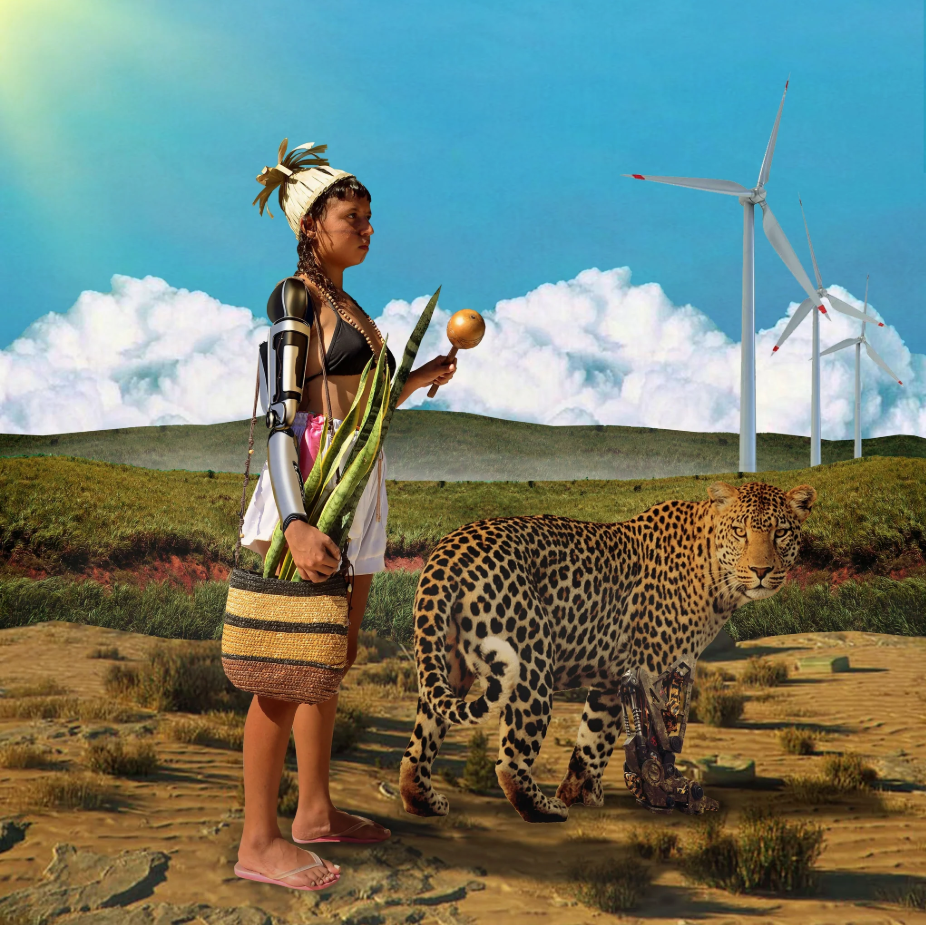
The Indigenous Futurism you structure does not deal with the apocalypse as a future event, but as a catastrophe that began in the fifteenth century, proposing a synchronic time in which millennia-old technologies, such as the khipu or the maracá, operate together with interdimensional realities. Since the progressive linearity of time is one of the most brutal tools of the colonial project for relegating original peoples to the past, how do the materiality and fluidity of digital collage operate in your studio routine to implode this official chronology?
I believe collage has its main inspiration in reality. We are already kind of androids. How long will it take before an Indigenous person has a Neuralink chip in their brain? Starlinks are already in the villages. I believe the central point is not to distort Indigenous reality using technology, as the non-Indigenous person sees it. In fact, this “pseudo-created” reality is what actually represents reality.
In the United States and Europe, there is a strong appeal around green energy utopias, often romanticized in art by the “solarpunk” movement. However, your work “Tapuya Raytech” places colossal wind turbines as elements of invasion in the northeastern landscape, denouncing the environmental racism of wind complexes that destroy traditional territories. How does your poetics use the fascination of futurism to attract the gaze of the Global North and then force that same audience to confront the reality that its clean energy solutions perpetuate the logic of colonial dispossession?
There is nothing better than “colonial dispossession” to describe the presence of wind energy in northeastern Brazil, resulting in the forced removal of the life that inhabits that place, causing severe impacts on the health of residents, fauna, and flora.
Residents living near wind farms, such as in the Agreste region of Pernambuco, report serious physical and mental problems, often associated with the continuous noise and infrasound emitted by the blades, causing auditory and neurological problems, psychological disorders such as anxiety, depression, stress, fear, and panic attacks, and physical symptoms such as nausea, dizziness, tachycardia, and body tremors.
In addition to socio-environmental impacts, there is damage to fauna and flora, destruction of native vegetation, erosion, deforestation, and interference in the habitat of local animals. There are impacts on animal production and reproductive problems. Birds and bats die due to collisions with the blades.
Wind energy serves as a marker of the temporality we live in and as a perspective of future continuity, as well as leading the public to reflect on all these problems caused by this form of energy. It creates a link between the colonial processes of past centuries and these current ones.
Silicon Valley and the North American technology industry dominate the infrastructure and databases of Generative Artificial Intelligence, systems that frequently make original identities invisible or caricature them. You have taken part in research projects, such as “INDIGENIA,” seeking to hack these tools through the Andean concept of Buen Vivir. What are the ethical and structural limits of trying to forge Indigenous epistemic sovereignty using corporate algorithms built from extractivist logics?
There is no sovereignty and there is no correct path. Let’s begin the reflection by thinking about two things present in our everyday lives: the cell phone and the internet. Cell phones and the internet are widely used by Indigenous communities as a way to record their culture, denounce problems in their territory, and create networks of articulation among Indigenous people who are geographically distant from one another. Despite all the problems that cell phones and the internet cause to physical and mental health, they are necessary today. The same will happen in the near future with AI, which will bring many problems to the world, but perhaps it will be harder to survive in the world without it, even with all the harm it may cause us. So there is no right or wrong for us, since we have no decision-making power at all in the end-of-the-world projects created by the global superpowers.
Are you our next spotlight artist? Submit the form to apply to be featured!
We share works by digital artists as well as digital arts exhibitions, events, and open calls daily on Instagram — follow us for more and subscribe to our newsletter so you don’t miss new blog posts.

![Project Spotlight: pifmgr.dll’s [M]ETAL✨ @pifmgr.dll is a digital artist working at the intersection of audiovisual design, 3D experimentation, and atmospheric world-building. His project [M]ETAL explores metal both as a physical material and a](https://images.squarespace-cdn.com/content/v1/63b2fdbe4376de5bfdc6771f/1779108338452-QO04Q3MMJ3VMU8PJV1MD/image-asset.jpeg)