Fragments of Color: Exploring Da Li Poghosyan’s Mosaics in Dilijan
By Tobias Zom
It is special to encounter artworks in a situation where it is not just displayed; rather, it becomes a part of the environment. A staircase is generally perceived to be an element that helps one move up or down to another level. When walls and steps of a staircase become adorned with mosaics, then movement through the environment becomes a visual experience as well.
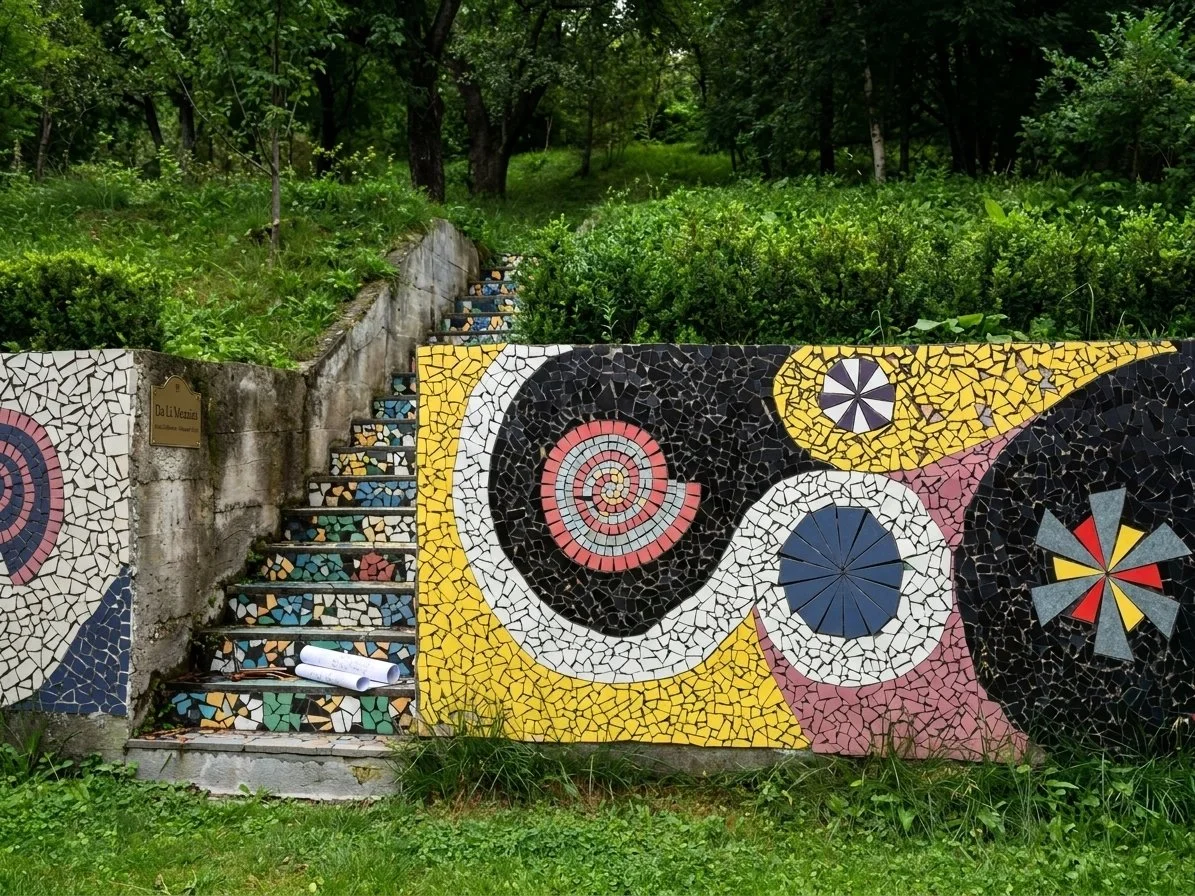
A summerhouse in Dilijan, Armenia, has been designed in such a way that there is an instance of such an encounter. A diagonal staircase surrounded by lush vegetation leads towards the green landscape of the hills with a retaining wall beside it that has vibrant mosaics. Smaller designs are placed on the vertical surfaces of the stairs. It feels like the mosaics make the biggest impact but the designs on the stairs add detail that might not be noticed right away. I am not totally sure about how the whole scene comes together though.
A Staircase Transformed by Color
The primary visual impact of the piece can be attributed to its color and motion.
In the case of the retaining wall, there are prominent, twisting forms set against a background of mustard yellow. There is a huge, twisting spiral design that has been created using coral-pink and white colors within a darker, comma-like curve. There are also circular patterns, much like pinwheels or sunbursts, which provide contrast by making use of the colors purple, white, navy blue, red, yellow, and gray.
However, the designs are not perfectly consistent. Rather, the designs have been made using broken ceramic pieces.
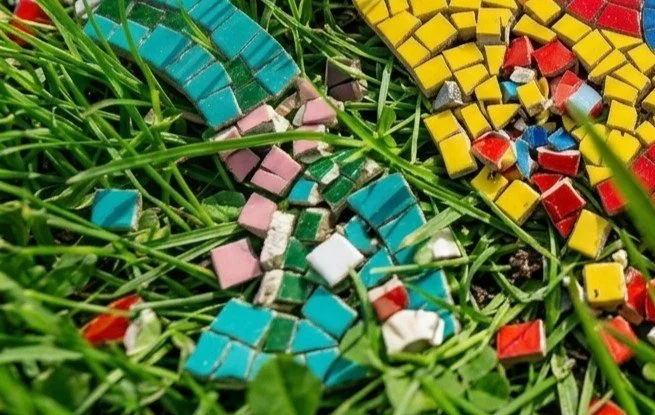
The surrounding area takes the application of fragmented pieces of art to an entirely new level. In the close-up picture, colored ceramic fragments are seen lying amid the blades of grass with pieces of turquoise, pink, yellow, red, and orange scattered on the greenery. It seems that some of the fragments have bits of grout left on them while others seem to have uneven edges.
It is clear that the fragmented pieces are as fascinating as the final product of art when viewed in this perspective. The fragmented pieces of art are nothing but pieces of color and textures before being formed into something bigger and beautiful.
The Logic of the Fragment
This transition from single element to a bigger picture is an important element in the visual language of the mosaics.
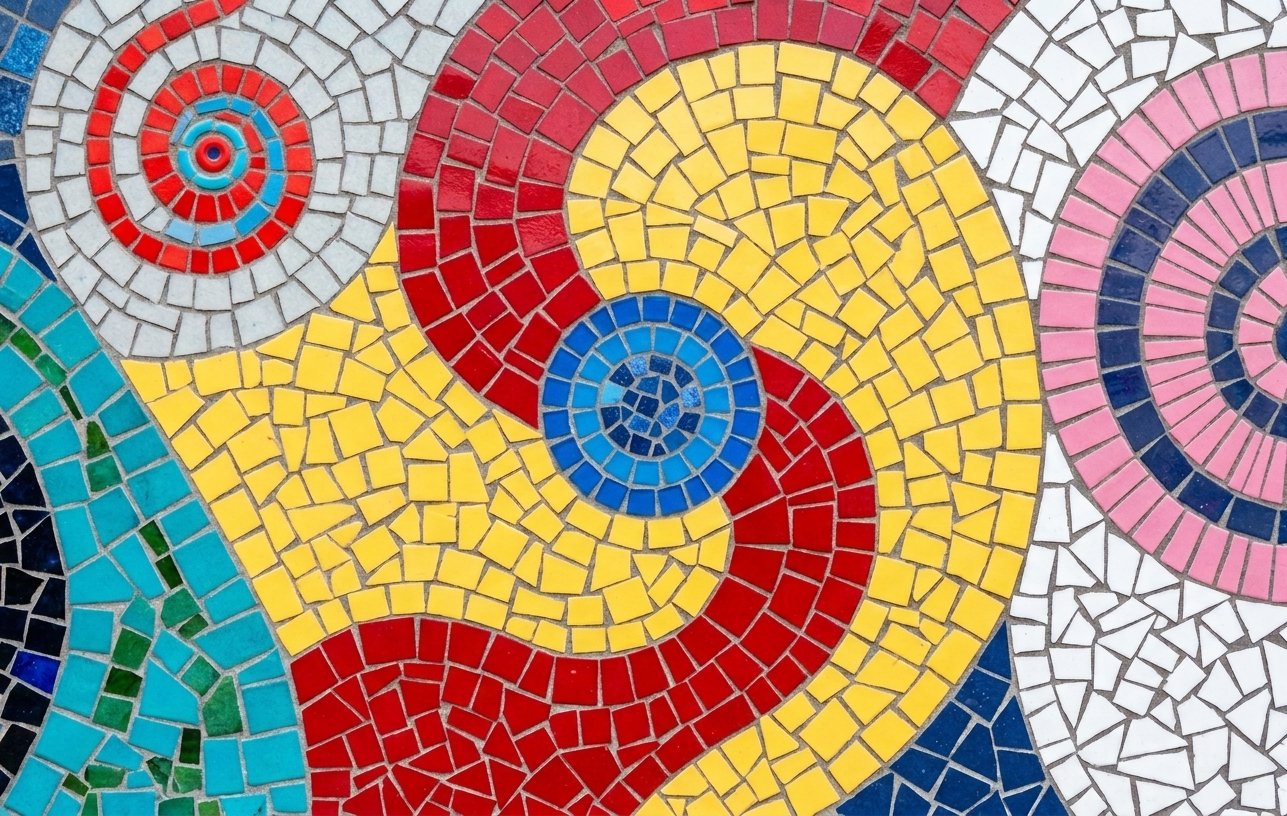
Another close-up shot shows how complicated the designs that can be created from seemingly simple components can be. The big double spiral that consists of interlocked red and yellow ribbons is the main feature of this image. In the center there is a small blue circle surrounded by a series of concentric circles that include combinations of orange, red, turquoise, pink, navy, white, and grey colors.
The close-up also highlights the quality of craftsmanship in the works. The elements are not regular but irregular, and the grey lines of grout are clearly visible between them. An apparently simple graphic becomes a set of separate pieces when seen from up close.
For digital artists, it provides an interesting example. The digital image can be created with use of pixels, vectors, layers, shapes, textures, patterns, or repeats. While the physical process of making a mosaic is entirely different, the visual process is quite similar.
Patterns That Invite Movement
The work of art also varies depending on the viewer's viewpoint.
The staircase goes up in a spiral and merges gently into the surrounding landscape. While climbing the stairs, one will see different parts of the mosaic at varying distances. The larger compositions on the wall behind are better seen from a greater distance, while the smaller decorations of the stair steps motivate one to get closer to look.
Each step has its own combination of the patterns that are made out of different shades of teal, blue, orange, cream colors and more. In contrast to the idea of creating a continuous work of art for the whole staircase, the composition gives each part of it its own unique identity.
It brings rhythm to the art.
One is not standing in front of a single immovable picture. Instead, it accompanies the movement through space.
This makes a nice lesson for the digital artists who do not have to confine themselves to the composition within the frame all the time.
The Character of Imperfection
When one works digitally, one of the benefits that they are able to achieve is the fact that they are going to be able to achieve precision. They are able to create accurate duplicates or shapes, precisely aligning the lines or colors used.
In contrast, the mosaic wall offers the opposite experience.
The ceramic pieces of the wall are uneven in form, and not every edge of each piece is necessarily the same. Upon seeing the composition, one can notice minor differences in the way it is assembled, but one must take into account that these imperfections serve as an important element of how the work is presented.
When one looks at the mosaic closely, one can see how the pieces are divided by a grey element inside the design, and at the same time, they shine and glow in a different way.
Thus, when making art in the digital stage, the artist can consider different ways of making a surface of an artwork appear much less uniform.
From Everyday Objects to Digital Images
The same care for small visual choices can be seen outside of fine art. Take a travel perfume, for instance. Its size and shape, as well as its packaging and color, are all deliberate design decisions, with each component contributing to how the overall object is perceived.
Digital artists make similar choices when combining visual elements to create a clear and engaging composition. For example, a meme creator can bring together imagery, typography, color, and layout in a simple format while still creating a strong visual impact.
At first, there may seem to be a significant distance between these examples and ceramic mosaics. However, the principle remains the same: individual elements acquire meaning through their place within a larger composition.
Poghosyan’s work makes this principle visible in a physical setting.
When Art Becomes Part of a Place
When talking about the installation, one of its most noteworthy characteristics is that the mosaics do not seem like they were thought out separately from the staircase. The wall, steps, surrounding greenery, and artwork come together to form one visual combination. The greenery serves as a quiet natural decoration for the vividly colored geometric surface, while the staircase makes a path through it.
The mentioned contrasting features of nature and the artwork are significant. The spontaneity of nature can be found in the peculiar quality of the crafted mosaic pieces, while vivid geometric curly designs create a certain visual order.
Thus, this art installation alters the perception of the staircase. It remains a practical means of moving from one level to another but turns into a set of colors, shapes, textures, and patterns too.
This idea is very important for professionals designing in the digital realm. The majority of digital art exists in the frames of defined interfaces and screens. Physical forms of installation give a different perspective on the issue and show that design can be integrated into architecture and change the way people perceive the area of space.
Looking Beyond the Screen
The mosaics of Da Li Poghosyan in Dilijan illustrate the relationship of the parts to the whole.
The ceramics are broken in order to produce compositions. They are colored to create rhythm. The stairway gives movement, while the surrounding space provides context of the work.
For digital artists and designers, the experience of observing a physical and not digital process becomes significant, since it helps to pay attention to such qualities easily hidden behind the screen as texture, material, size, imperfection and how the composition changes when the spectator moves through it.
All in all, the mosaics show that an artwork does not have to be separated from the environment. Sometimes, it can become part of the path itself.
In Dilijan, the stairs represent not just a road among landscapes, but become a composition made of parts.