By Cansu Waldron
Andy Baird is a digital artist and the creator of Stiff Competition, a series of six original characters styled as 1994 action figures and placed into individually composed scenes. Each work is presented as a one-of-one digital artwork, framed by the fictional history of a toy line that never existed: an invented manufacturer, a cancelled 1990s product range, and even a decommission notice. Rather than pretending these objects are lost pieces of pop-culture history, Baird makes the fiction part of the work, building an alternate archive around characters and stories that are entirely his own.
Andy came to digital art after thirty years working in network engineering and service management, having spent much of his life with specific images in his head but without the means to make them. He describes his role as directing rather than executing, deciding what a scene should be and then working through version after version until the image gets close to what he imagined. The subjects are often rooted in his own experiences, with his Travel Series drawing on places he has actually visited and his portraits inspired by expressions he has noticed on real faces. There’s no grand artistic claim behind the work; Baird simply wants to make something that might catch someone while they’re scrolling and make them smile.
We asked Andy about his art, creative process, and inspirations.

Can you tell us how Stiff Competition first came about? What was the initial idea that made you want to build this fictional toy line?
Three used action figures, no packaging, a pound for the lot. Bought at the Wednesday afternoon market, walking with a friend to the pub.
We sat down and carried on chatting, and somewhere in there we started playing with them. They became the stars of a photo shoot on the table — my phone camera, my friend's torch doing the lighting. The figures ended up in poses so lifelike, and so loaded with innuendo, that I wanted to do something more with them.
That was the spark, and for a long time it stayed nothing but a spark. The shots got turned into poster art — enlarged, framed, given to friends — and that was as far as it could go. The originals were copyrighted brands, so anything larger was closed off.
It was years later, after I left the corporate world, that I finally had time to think about what I could actually do with it — how to share the fun I'd had that afternoon with people who weren't there.
The difference between then and now is what made it possible at all. Those first shots were just photographs — real figures, a real table, a phone. Point and press. Making my own characters was a completely different proposition: I can't draw, I can't sculpt, I've no design training whatsoever. For years that was simply the end of the road.
AI is what removed the wall. It gave me a way to get what was in my head into an actual image without the twenty years of craft I never put in.
So it started as nothing more than an idea to make my own characters and my own images. Then the six needed a reason to belong together, so they got a cancelled 1994 toy line and a manufacturer behind them, and the story expanded from there. The merch, the digital art, the social media all came afterwards. None of it was planned on that pub table.
The fiction isn't the joke. It's the scaffolding that lets the joke stand up — and building my own characters rather than borrowing turned out to be the better outcome anyway. Nothing here is borrowed.
You spent decades working in a completely different field before becoming an artist. Do you think all those years of looking at the world through a technical/problem-solving lens changed the way you now construct images?
Yes — though the bigger effect wasn't on the images at all.
Stiff Competition is a registered company with a director and a staff of zero. AI is the team. I had no background in art, ecommerce, blockchain or code when I started, and everything is self-taught: the shop, the minting on the blockchain, the wallet, the email flows, the social pipeline. I designed and planned each piece, then built it, and the business now largely runs itself.
Thirty years in network engineering and service management is what made that possible — not the building, the discipline. AI does the actual work. What I bring is knowing what to ask for and whether the answer is any good: design it before you build it, decide what has to stay consistent and what's allowed to vary, assume it will break and know what happens when it does, automate anything you'd otherwise do four hundred times by hand. That's ordinary infrastructure practice, and it turns out to be exactly what one person needs to run something that would normally take a department.
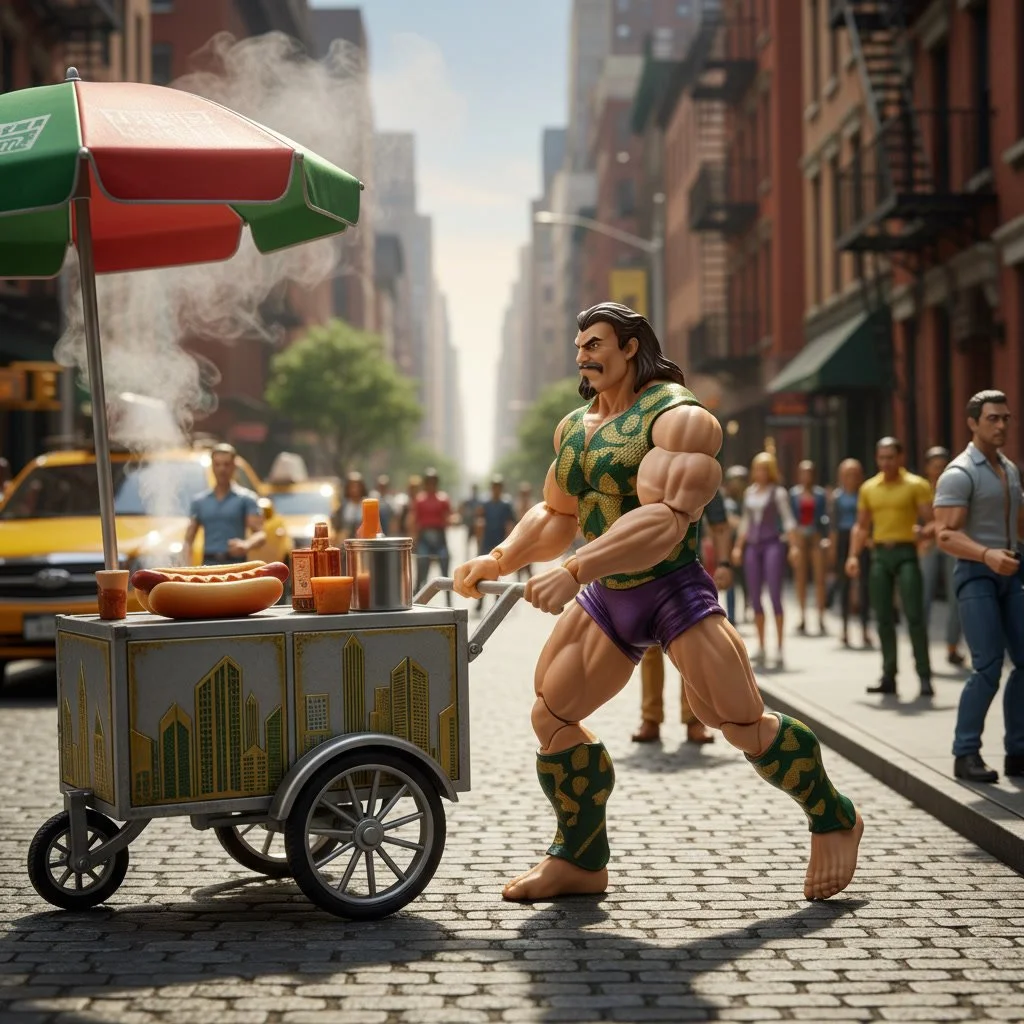
The art is made the same way — AI is the tool there too — but it's the one part I refuse to put on a pipeline. Every piece is directed individually. What the engineering habit contributes is consistency: six recurring characters across hundreds of environments is a systems problem before it's an aesthetic one. The same jawline, the same joint articulation, the same wear on the same plastic, in Times Square and in a temple courtyard. Making one striking image is easy now. Making the four hundredth that still unmistakably belongs to the same line is the actual work.
On the build side, it's worth saying the ground moved under me while I was working. What took days of wrestling six months ago takes an afternoon now. A fair bit of what I built early on I'd build differently — and faster — if I started today.
The characters and scenes are fictional, but many of them come from your own experiences and memories. How do real places and people become transformed into these little worlds?
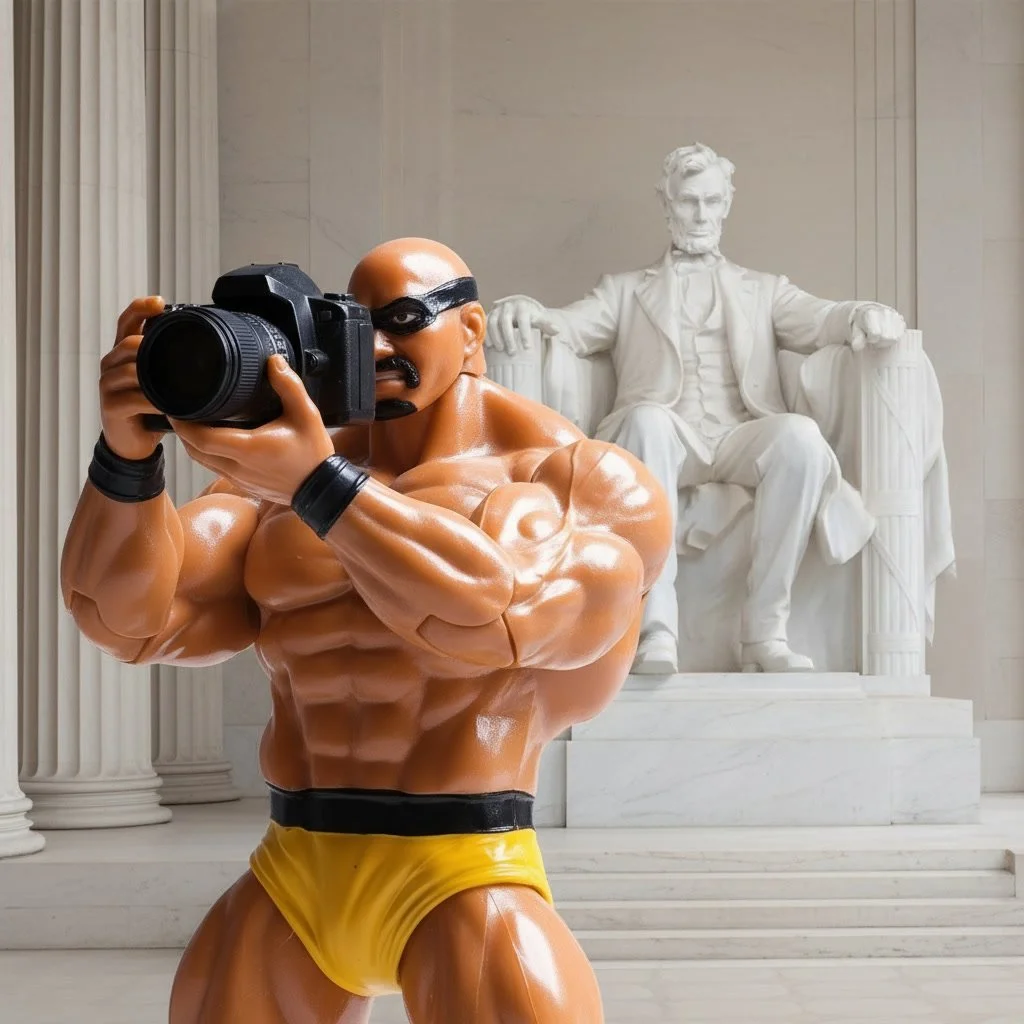
The Travel Series comes out of my own traveling. When a character turns up somewhere, it's usually somewhere I've stood myself — which is why the details tend to be the ones you'd notice on the ground rather than the ones on a postcard.
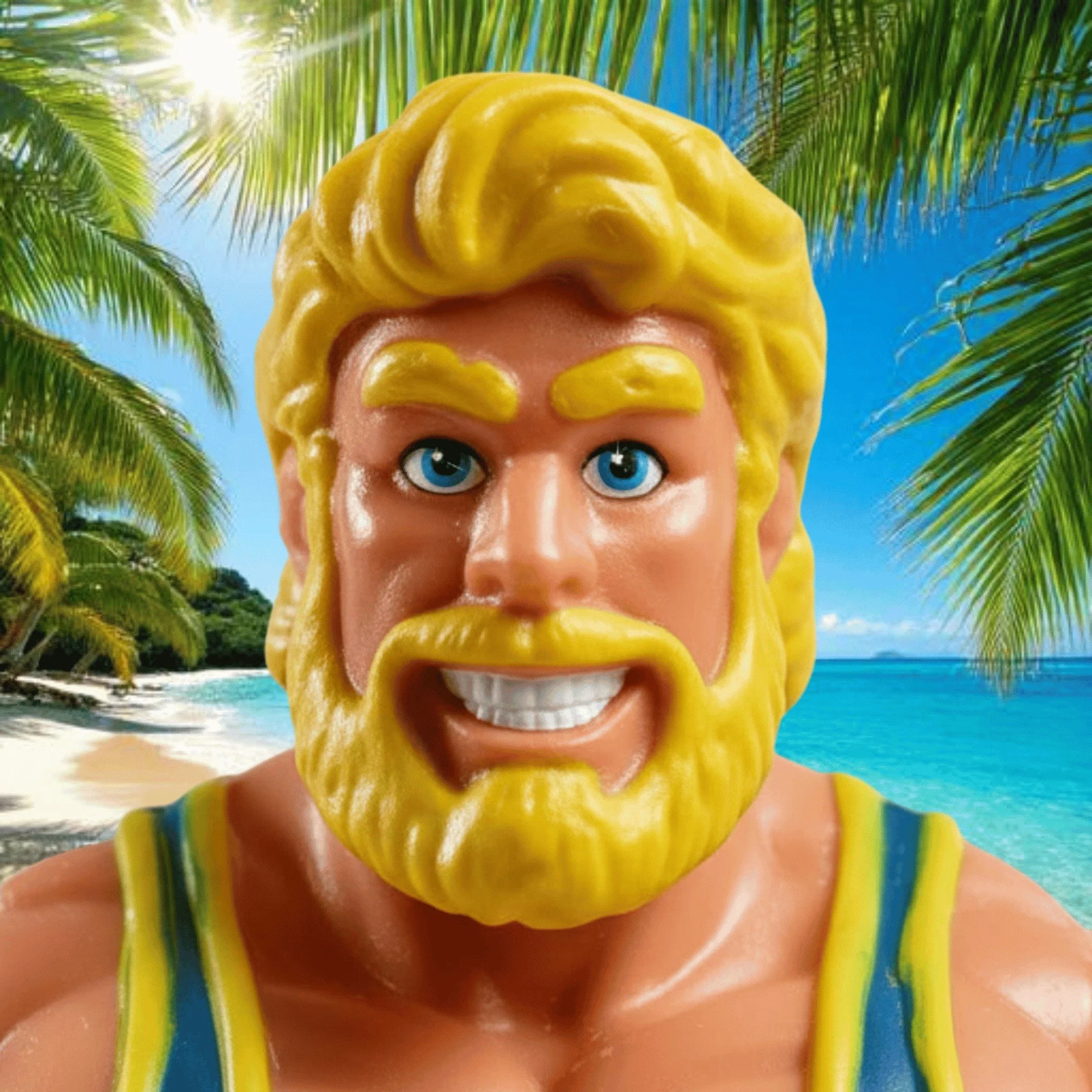
The faces are where most of the work goes, though. A moulded plastic face can only do one expression, and six characters who can only do one expression each would get dull by the tenth image. So I push for something underneath it — a flicker of doubt on a jaw built for certainty, or total conviction on a face that has clearly misread the room. That's what gives them depth rather than just a pose.
It's the same instinct as that first photo shoot on the pub table, just with better tools. Put a rigid plastic figure into a real place and let the place do the work.
Your work plays heavily with nostalgia, but it isn't simply recreating something from the past. What do you think we're actually nostalgic for when we look at objects and imagery from our childhood?
Not the objects. I think it's the certainty.
A 1994 toy aisle was a place where everything was legible. The strong one was obviously strong, the fast one was obviously fast, the packaging told you exactly what you were getting, and nobody was being ironic about any of it. That clarity is what people miss, not the plastic.
Which is why I don't reproduce the era. I put the figures into a 2026 that rewards none of it — self-checkouts, flat-pack furniture, everything going contactless. They still stand like they're about to save something, and there's nothing to save. They take all of it entirely seriously, and that's what makes it funny.

You say you aren't trying to make a profound statement — you just want someone scrolling past to smile. How important is that sense of play and humor to your practice?
It's the entire point, and I'd rather be honest about the ceiling.
I'm not making an argument. There's no thesis about consumerism or masculinity buried in there, and if someone finds one they're welcome to it. What I want is for a person mid-scroll, having a mediocre day, to stop for a second and grin at a wrestler pushing a hot dog cart — the same laugh two people had round a pub table, handed to somebody who wasn't there.
That's a small ambition and I'm at peace with it. Play is also what keeps the work honest — the moment I start trying to be important, the images get worse. I can watch it happen.
The names are jokes. The descriptions are jokes. It runs on innuendo from top to bottom, and that is very much the point.
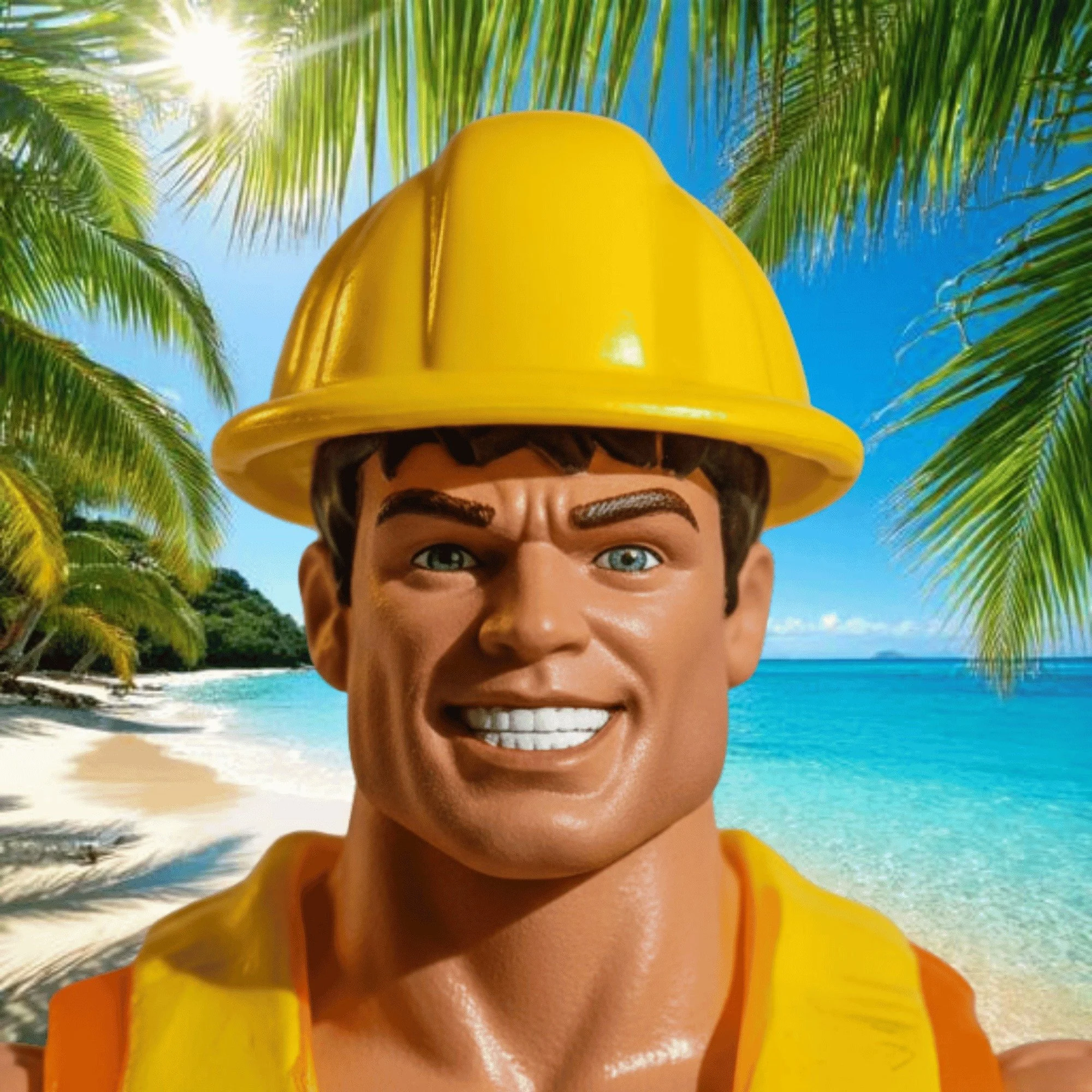
Stiff Competition is currently a series of six characters. Do you see this fictional universe continuing to expand?
The cast doesn't. Six is a fact about the line rather than a starting position — the full roster of a range that never shipped. Adding a seventh would be admitting the fiction was never real.
The situations expand endlessly, though. They've barely started travelling, and the further they get from anything heroic, the better the work gets. The strongest pieces are the most boring errands.
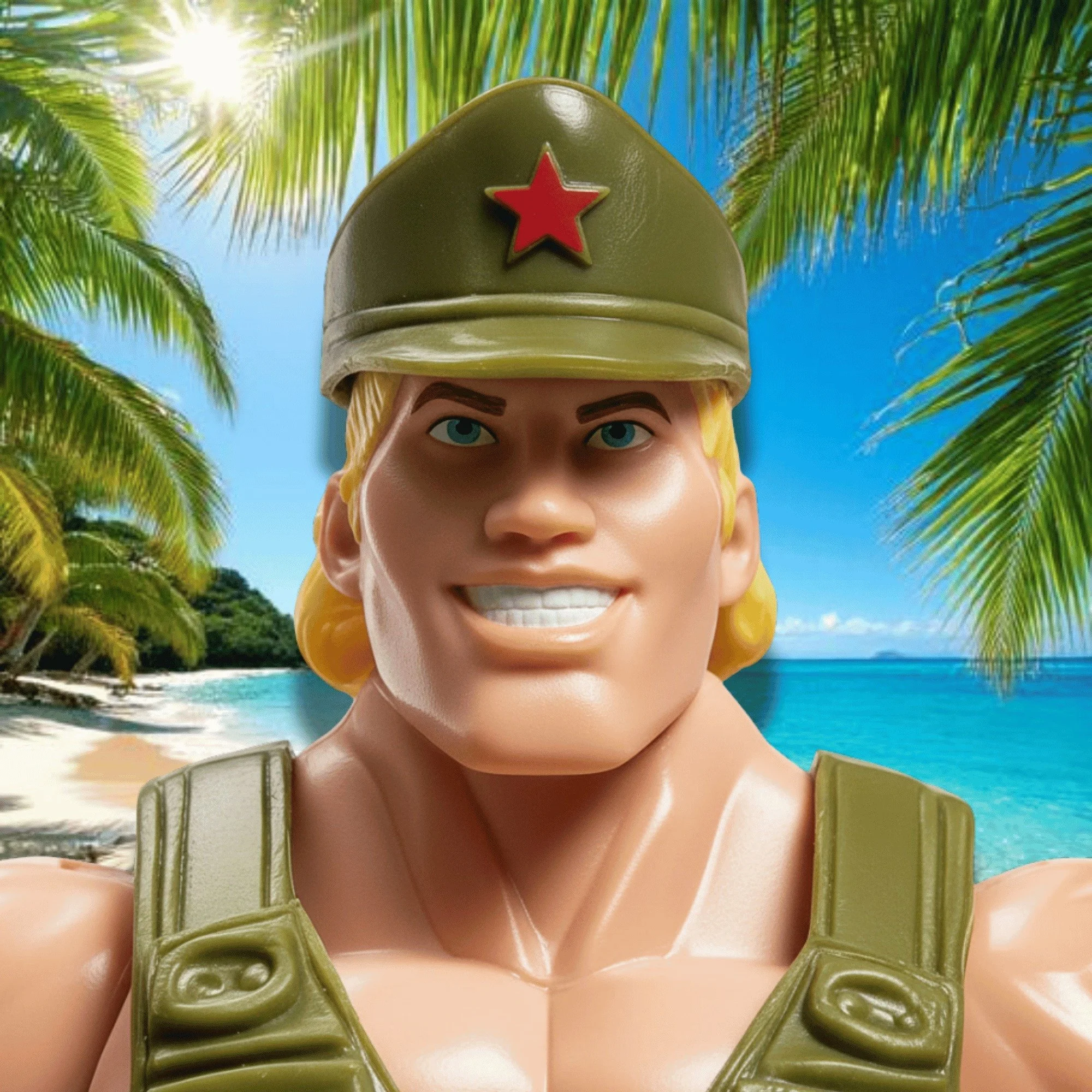
If Stiff Competition really had been a forgotten 1994 toy line, what do you imagine happened to it?
Nothing dramatic, which is the part I like.
It would have been shelved late — after the tooling was paid for and before anything shipped. A range that got as far as the sell sheet and no further, because someone sensible finally read the character names out loud in a meeting. Then a warehouse, a change of ownership, a pallet nobody had a manifest for.
No fire, no scandal, no lost masterpiece. An expensive mistake that was quietly easier to store than to destroy. Most cancelled things end that way.
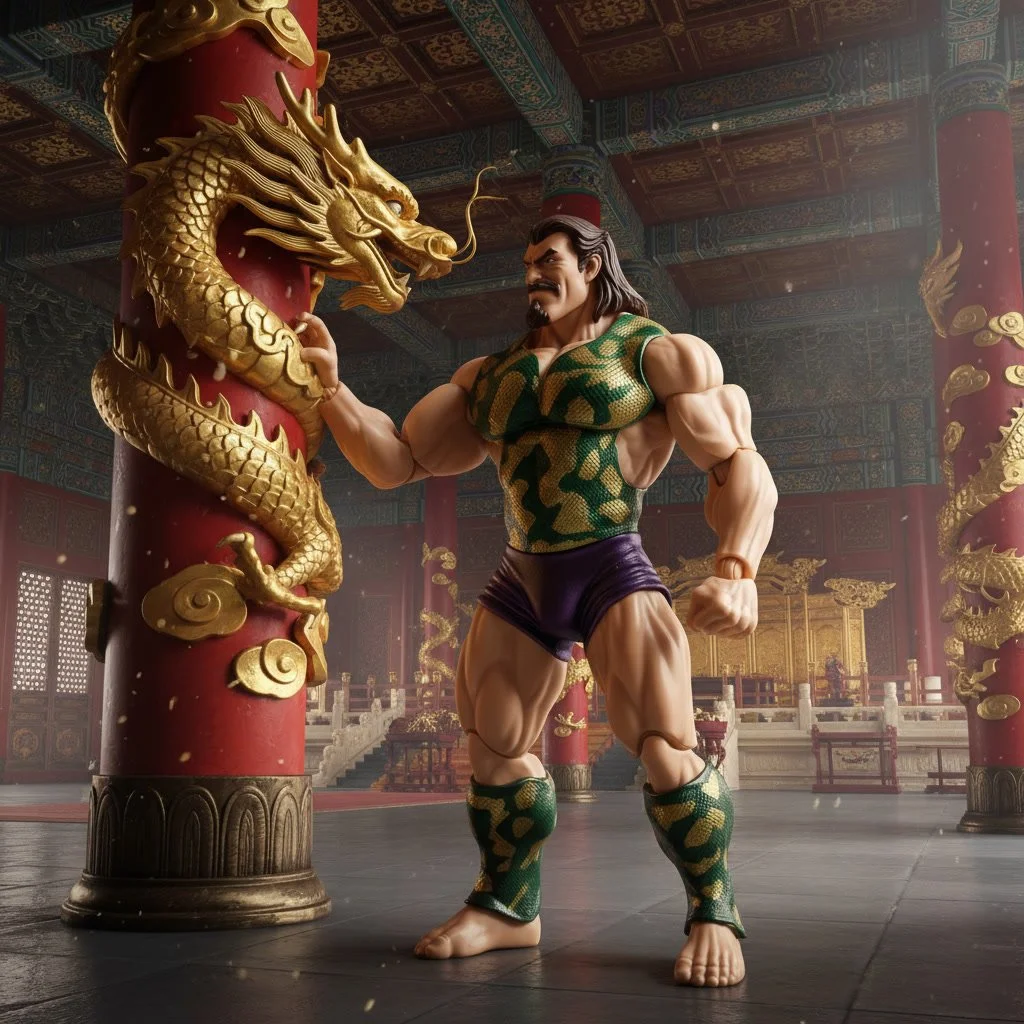
What is a fun fact about you?
I've been to around 120 countries, several of them many times over. It's the thing I'd have kept doing whether or not any of this existed.
What else fills your time when you're not creating art?
More of the same, mostly — still traveling, still exploring places I haven't got to yet. Beyond that there are a few other ideas that have been trying to get out of my head for a while. Once the launch settles down, they're next.
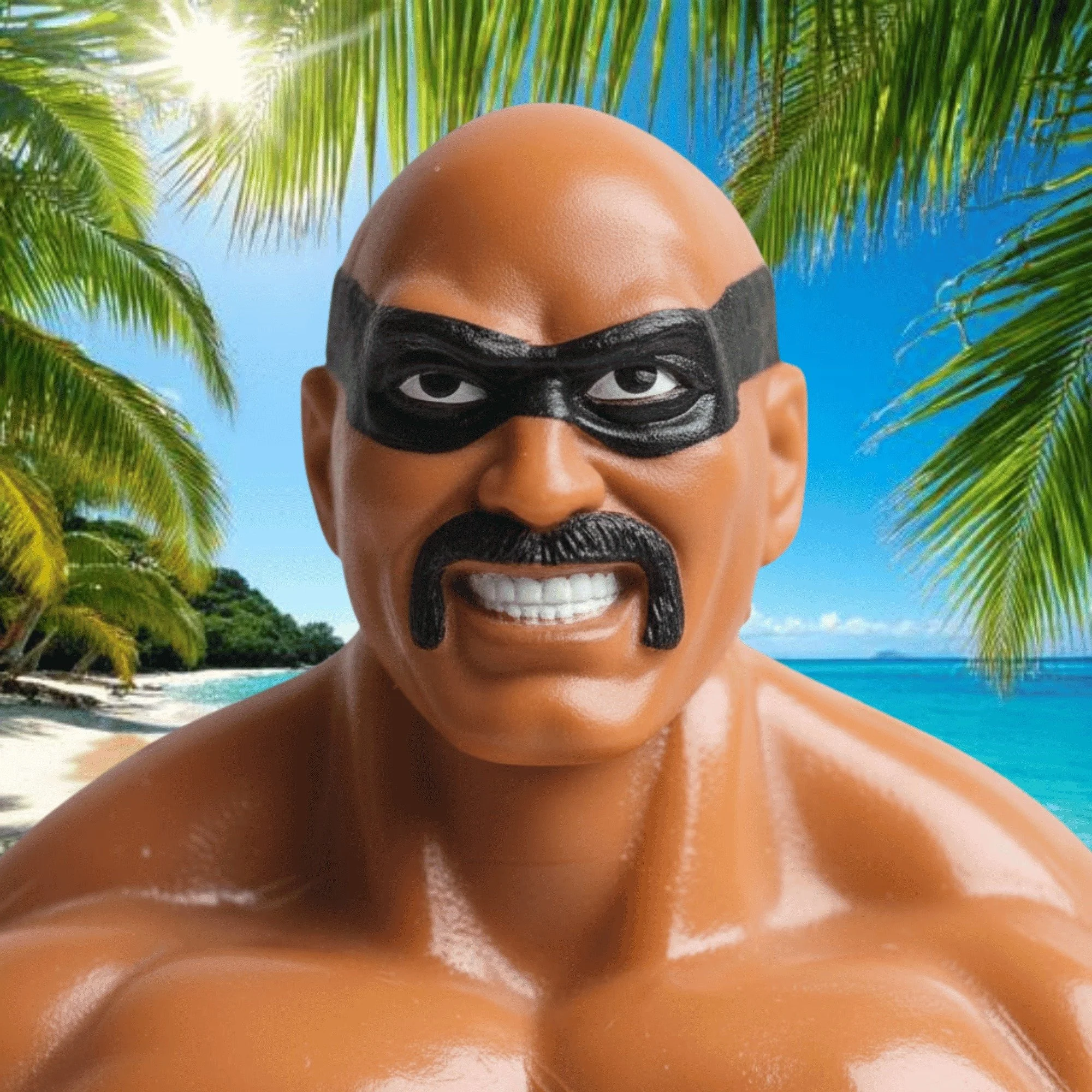
Are you our next spotlight artist? Submit the form to apply to be featured!
We share works by digital artists as well as digital arts exhibitions, events, and open calls daily on Instagram — follow us for more and subscribe to our newsletter so you don’t miss new blog posts.
![Project Spotlight: pifmgr.dll’s [M]ETAL✨ @pifmgr.dll is a digital artist working at the intersection of audiovisual design, 3D experimentation, and atmospheric world-building. His project [M]ETAL explores metal both as a physical material and a](https://images.squarespace-cdn.com/content/v1/63b2fdbe4376de5bfdc6771f/1779108338452-QO04Q3MMJ3VMU8PJV1MD/image-asset.jpeg)