Her Own Fairytale of Japan: Marina Imar’s Geometric Cat Art Series
By Cansu Waldron
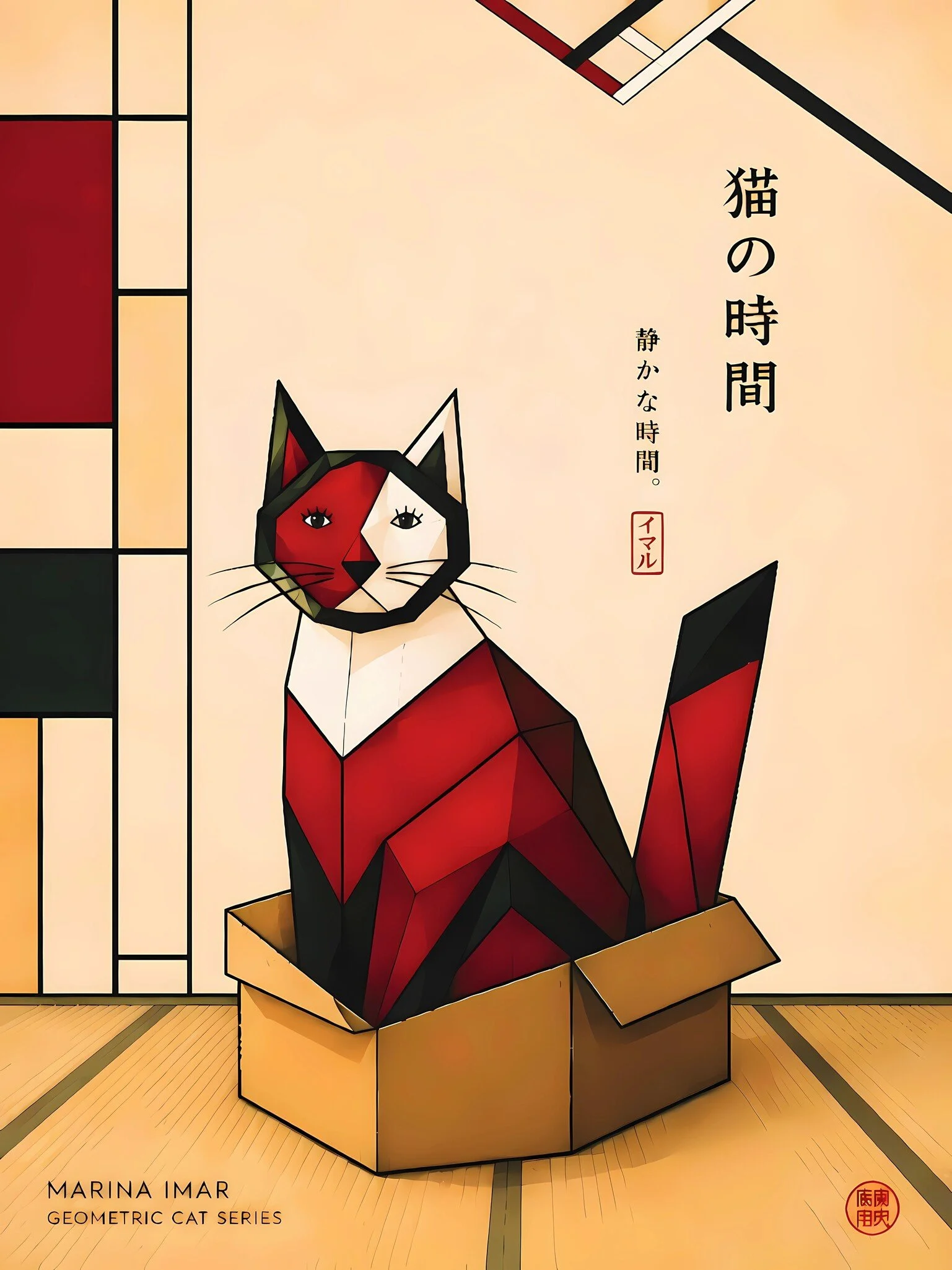
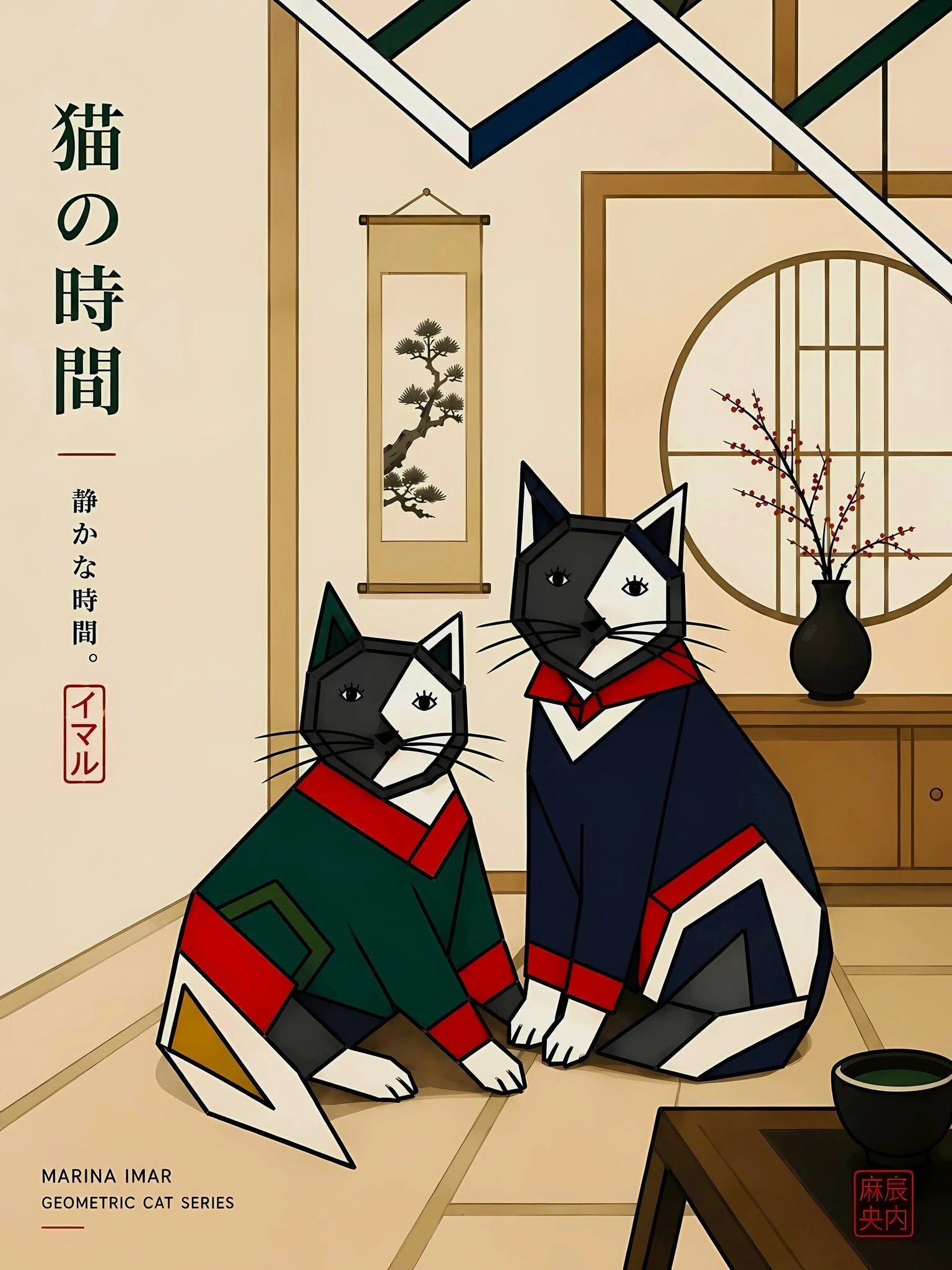
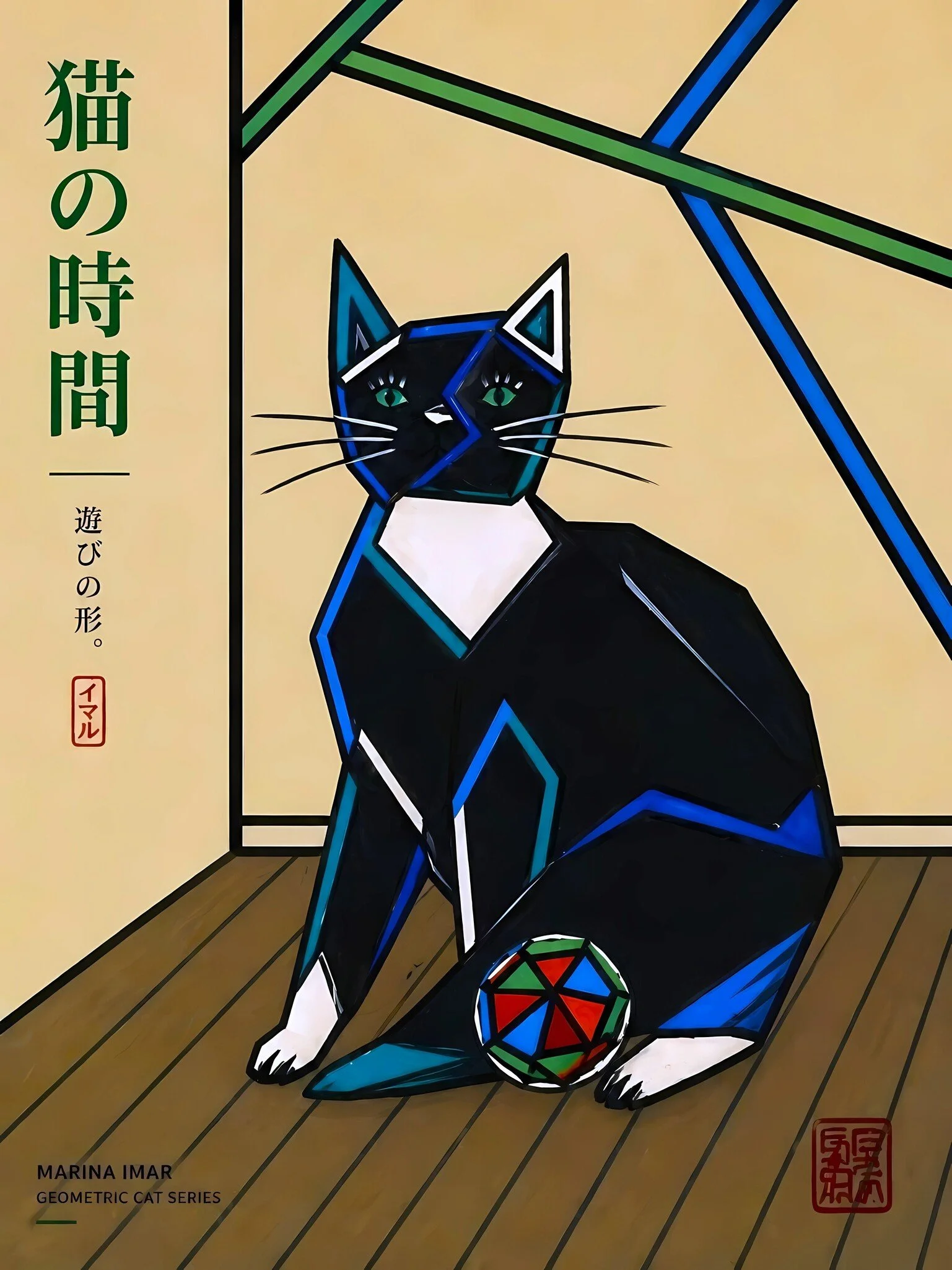
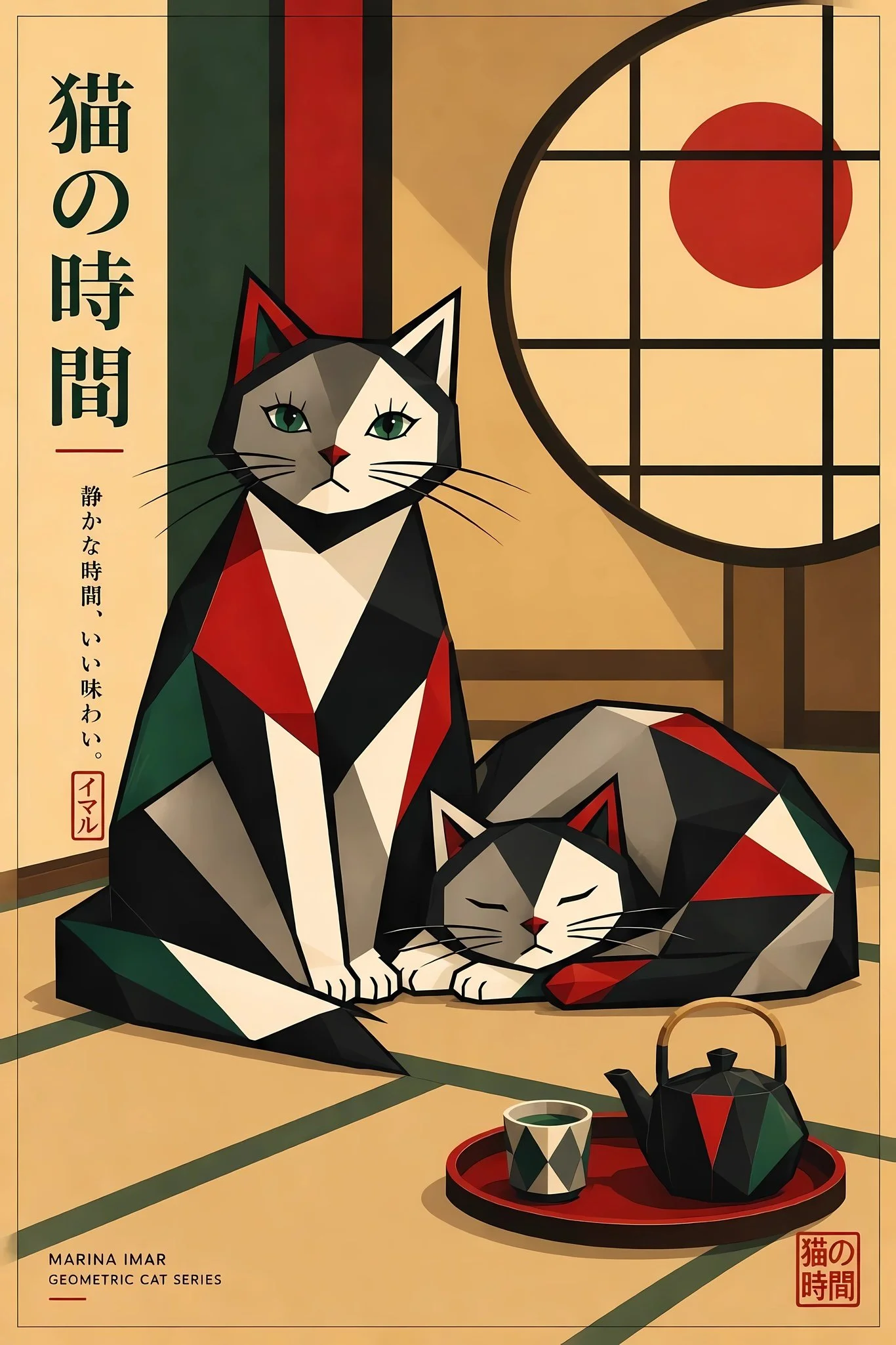
Marina Imar is an artist working across painting and digital art, with a practice shaped by geometric forms, expressive color, and elements of Japanese visual culture. She is interested in simplifying familiar objects, animals, and everyday scenes into basic shapes while preserving their character and mood. This approach comes through particularly in her Geometric Cat Art series, where cats become playful characters through combinations of geometry, color, movement, and humor. Rather than treating geometry as something rigid, Marina uses it as a flexible visual language that allows her work to move between structure and abstraction while remaining lively and recognizable.
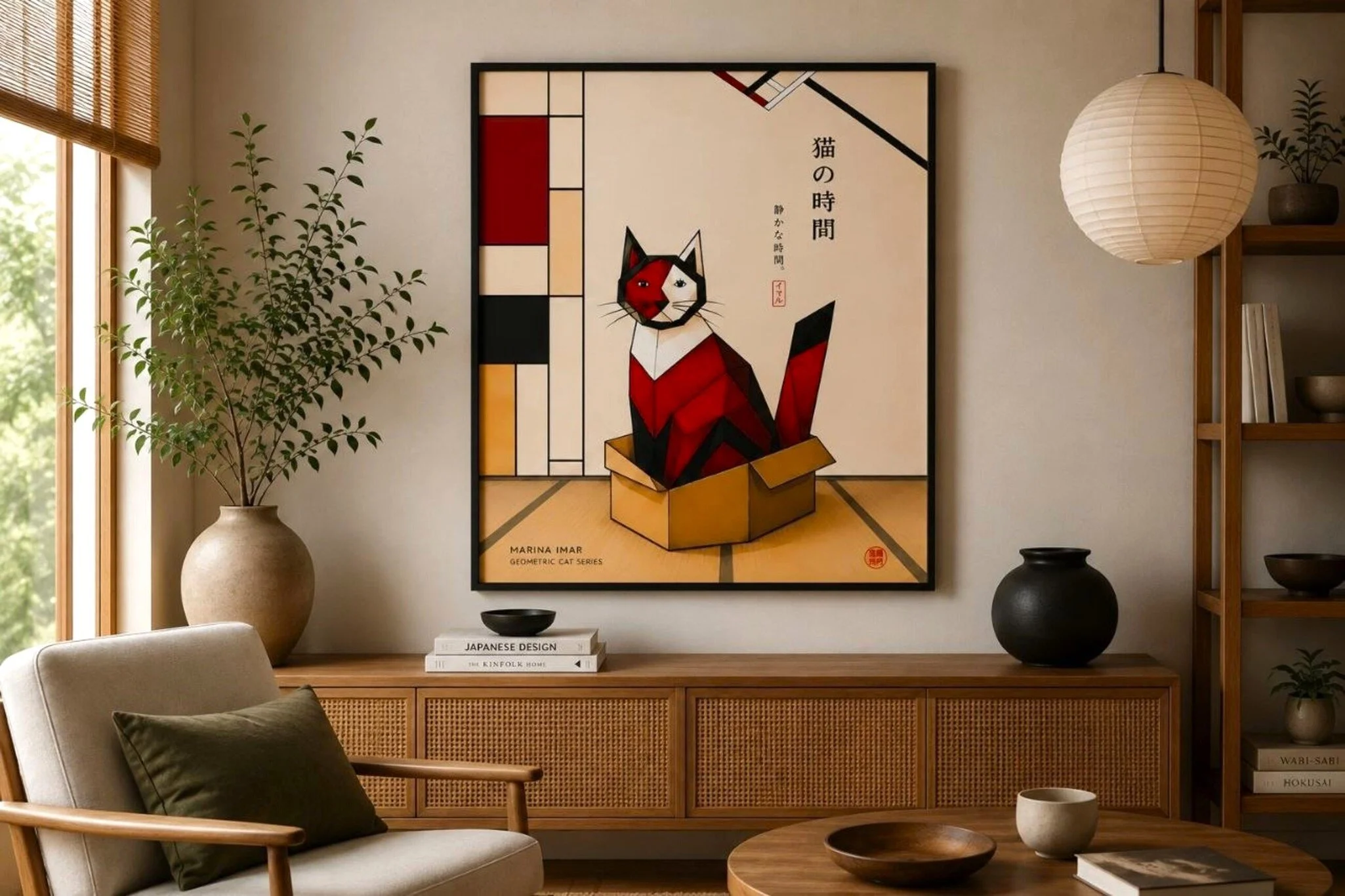
Cats are a natural subject for this exploration because of their distinct personalities and expressive movements. Marina observes them in ordinary situations, from climbing into boxes and playing to simply occupying a space with complete calm, finding humor and meaning in these small moments. In Geometric Cat Art, their silhouettes and gestures are reduced to simple geometric forms without losing their individuality, turning everyday observations into graphic compositions that feel both playful and thoughtful. Through this balance of simplicity and personality, Marina uses cats to explore the small details of everyday life and the different ways we learn to see the world.
We asked Marina about her art, creative process, and inspirations.
What draws you to geometry as a visual language?
I am drawn to geometry because it allows me to see the familiar world in a new way. I enjoy simplifying real objects, animals, or entire scenes into basic forms while preserving their character, mood, and recognizability.
Geometry helps me build an image precisely through the relationships between shapes, lines, space, and color. But I don’t see it as something strict or cold. On the contrary, I like adding emotion, movement, expressive color, and a touch of humor to this structure.
I am especially interested in how simple geometric forms can convey the individuality of a character. With cats, for example, it is not only their anatomy that matters, but also their pose, movement, and mood.
I like finding a level of simplification where an image becomes almost abstract, yet remains alive and recognizable. Perhaps it is this combination of structure and freedom that attracts me most to geometry.
What is it about cats that makes them such interesting subjects for your visual language?
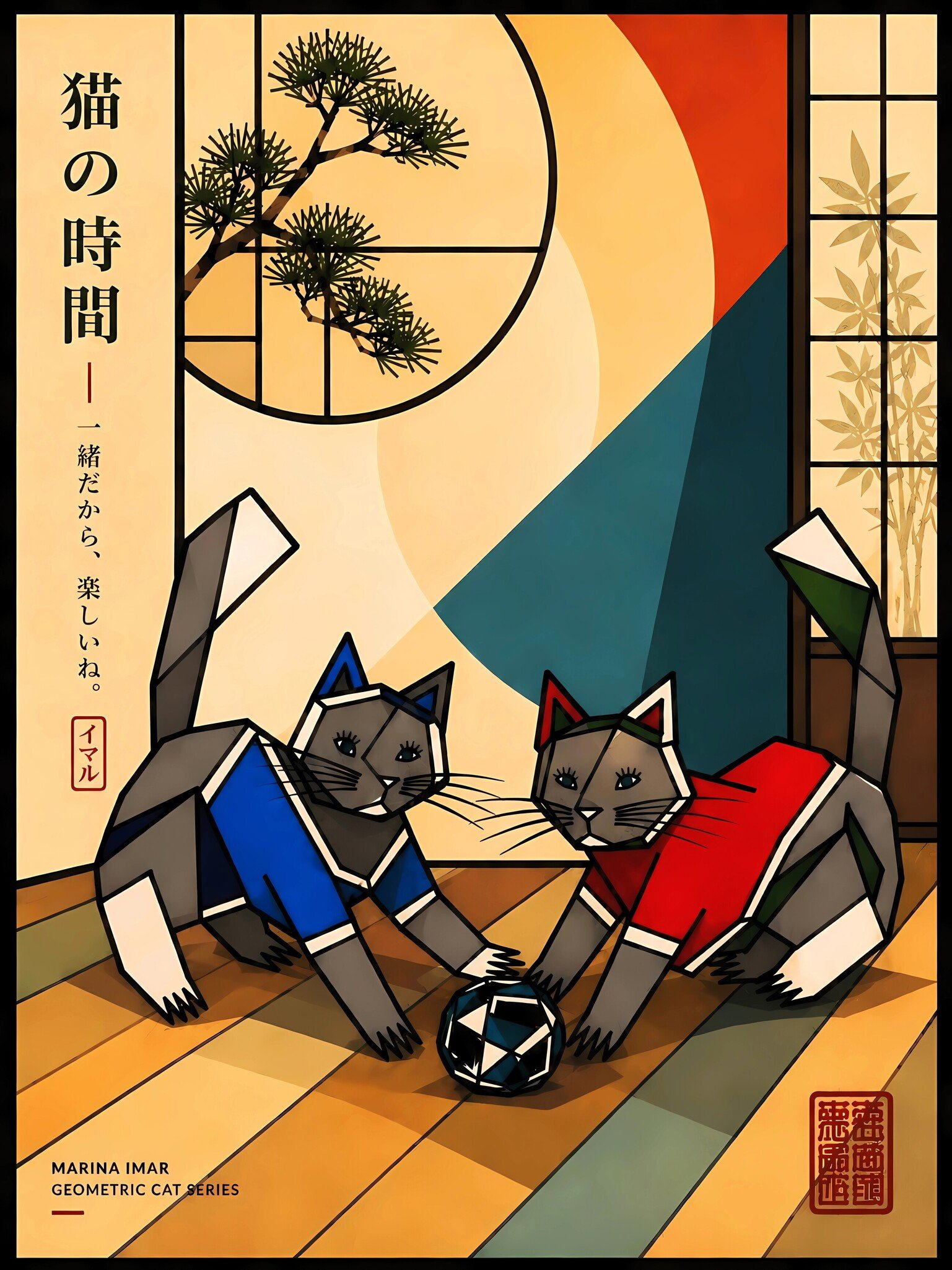
Cats interest me primarily because of their individuality. They are instantly recognizable, yet every cat has its own character, movement, and way of behaving. Even an ordinary pose or gesture can reveal something about its mood.
I enjoy observing cats in everyday life. They can turn an ordinary situation into a small scene — climbing into a box, playing, watching what is happening around them, sitting together, or simply occupying their space with complete calm. There is both humor and something almost philosophical in these moments.
From the perspective of my visual language, cats are also fascinating characters because their silhouettes, poses, and movements can be expressed through relatively simple geometric forms. At the same time, it is important not to lose their character.
That is why, in Geometric Cat Art, cats are not simply decorative images. They are characters through which I can explore everyday life, personality, humor, and the small observations that shape the way we see the world.
Are there any artists or creative influences that have had a significant impact on your work?
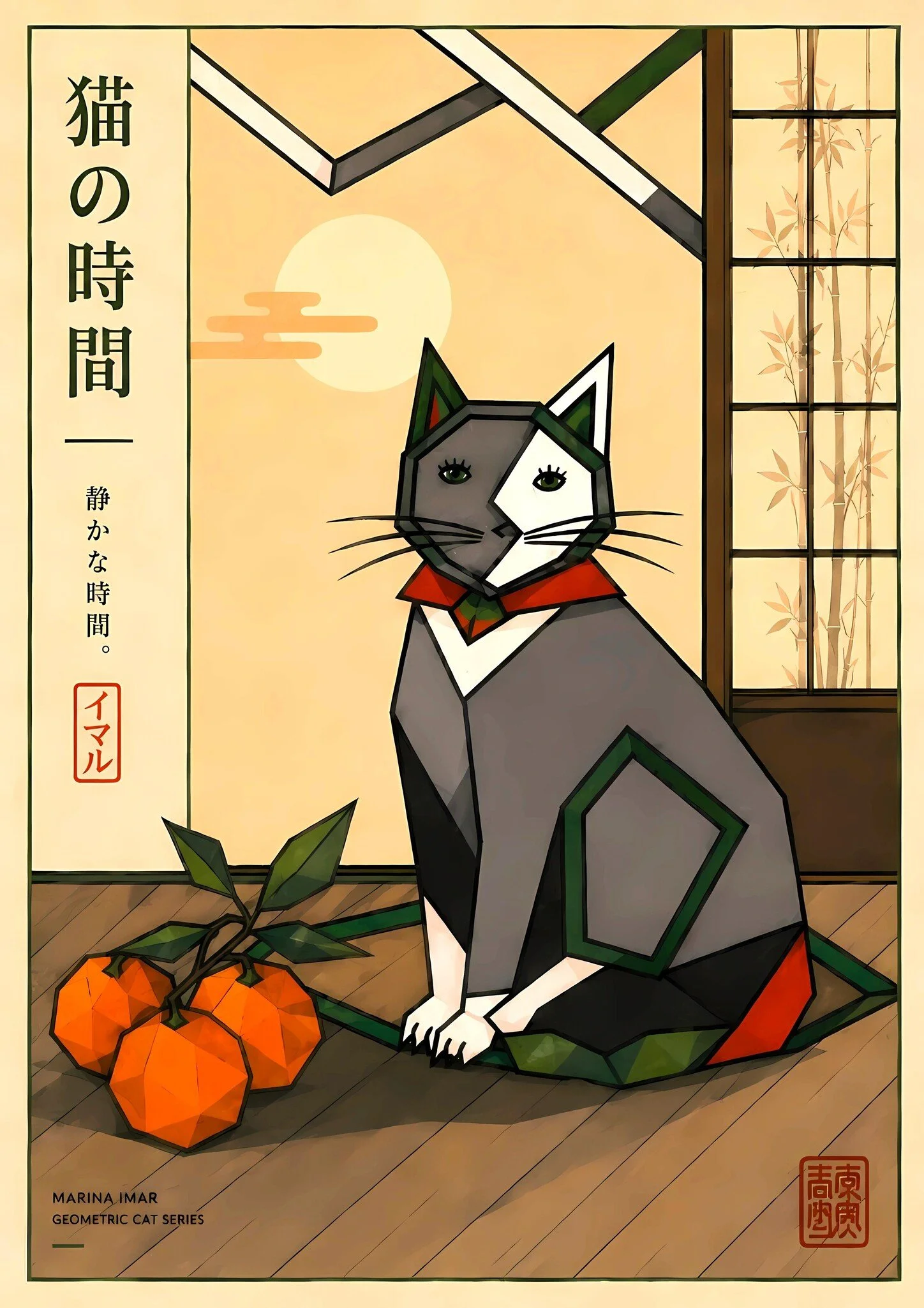
Artists of the early 20th-century avant-garde have had a strong influence on my work. It is difficult for me to name just one — I am inspired more by the avant-garde approach to art and the wide range of ideas it opened up.
I am drawn to their attitude toward form and color, and to the freedom to move away from literal representations of reality and see familiar things in completely different ways. This freedom is especially important to me: I do not want to see the world as something fixed, but rather keep looking for new ways to observe and interpret it.
I think this has strongly shaped my own approach. I can take an ordinary object or situation and transform it through geometry, color, simplification, and composition, giving it a new visual character. At the same time, I want emotion, personality, and recognizability to remain behind the formal play.
I see the influence of the avant-garde not as a set of techniques to reproduce, but rather as the freedom to look at the world in my own way and develop my own visual language.
Which aspects of Japanese art, design, or visual culture have had the greatest influence on you?
Japanese visual culture has become an important part of my artistic practice. I am drawn to Japanese culture as a whole — its distinctiveness and the way it differs from European traditions of perceiving art, space, and everyday life.
I am particularly inspired by the Japanese attention to simplicity and detail, its distinctive sense of space, the combination of decorative elements and restraint, and the ability to find beauty in ordinary things.
But I am not interested in simply using Japanese visual motifs. In a sense, my work is my own fairy tale about Japan. I collect what inspires me — architecture, interiors, objects, color combinations, graphics, and the atmosphere of everyday life — and then combine these elements with my own artistic language: geometry, expressive color, an avant-garde approach, and sometimes humor.
So I am not trying to create an accurate representation of Japanese culture. Instead, it is my personal vision of Japan — contemporary, slightly imaginary, and enriched by what I call contemporary avant-garde. I am interested in imagining what Japan might look like within my own artistic reality.
How does your working process differ when creating a painting versus a digital artwork?
For me, painting and digital art are two different ways of working with an image. Painting is a more physical and immediate process: the texture of the paint, the movement of the brush, the surface of the canvas, and even unexpected changes in color all influence the result. Sometimes these unpredictable moments become part of the artwork.
Digital art gives me more freedom to experiment. I can quickly change the composition, shapes, colors, and scale, try different variations, and return to previous decisions. This is especially well suited to my work with geometry, allowing me to precisely develop forms, rhythm, and color relationships.
At the same time, I see digital art as a fully independent artistic medium with its own logic and possibilities. In painting, I interact more directly with the material, while in digital art I work more with the possibilities of the image itself. But in both cases, my goal is the same: to find an expressive image and create my own visual reality.
What is a profound childhood memory?
One of my deepest childhood memories is connected with drawing. I was a child who drew a lot. I could spend hours with pencils or paints, creating my own images without thinking about whether I was drawing correctly or what other people might think.
Looking back, I think this was when I first discovered how fascinating it is to create your own world through images. Drawing was a natural way for me to observe, imagine, and express what I felt.
Perhaps that is why, even today, I see art primarily as a way to look at the world in my own way and create something of my own. In that sense, there is a very direct connection between the child who was always drawing and the artist I am today.
What is a fun fact about you?
I have a very good visual memory: I can remember an image I saw ten years ago, down to its colors and smallest details, but I can completely forget where I put something five minutes ago. Apparently, my memory simply prefers beautiful pictures.
Have you received any unexpected or memorable reactions to your work?
I have received many different reactions to my work, but one of the most unexpected happened at an exhibition. A collector looked at my work and, completely seriously, told me: “You’re cooler than AI.”
It made me laugh, but it also stayed with me. Perhaps because there is something very characteristic of our time in that comment: even when people look at art created by a human artist, they increasingly find themselves comparing it with the possibilities of artificial intelligence.
I took it as a very nice compliment, but with a sense of humor. After all, I am much more interested in developing my own visual language than competing with AI.
Are you our next spotlight artist? Submit the form to apply to be featured!
We share works by digital artists as well as digital arts exhibitions, events, and open calls daily on Instagram — follow us for more and subscribe to our newsletter so you don’t miss new blog posts.
![Project Spotlight: pifmgr.dll’s [M]ETAL✨ @pifmgr.dll is a digital artist working at the intersection of audiovisual design, 3D experimentation, and atmospheric world-building. His project [M]ETAL explores metal both as a physical material and a](https://images.squarespace-cdn.com/content/v1/63b2fdbe4376de5bfdc6771f/1779108338452-QO04Q3MMJ3VMU8PJV1MD/image-asset.jpeg)