When Drag Meets AI: Jake Elwes and The Zizi Show
By Burcu Konuralp
How can artists respond creatively to technologies whose structures exclude the very communities they seek to represent? Jake Elwes uses drag to confront the ways AI systems fail to recognise queer identities. By creating The Zizi Show, they bridge drag performance and deepfake technologies as a way of reclaiming technologies that can exclude marginalized communities. Through an artistic practice that remains inviting, engaging, and playful, Elwes addresses political, social, and structural issues around emerging technologies.
In 2019, Elwes created Queering the Dataset, a multi-channel digital video work presenting a series of faces continuously morphing into one another in a fluid motion. The vibrant colors of the makeup, the skewed facial features, and the exaggeration of forms dominate my experience of the work. Yet the compelling and playful visuals I see emerge from deeper ethical questions surrounding machine-learning systems that Elwes seeks to uncover. In this artwork, Elwes works with FFHQ, a facial-image dataset containing seventy thousand faces, which Elwes criticizes for its lack of queer representation and predominance of white, normative faces. Into this dataset, they introduced one thousand images of gender-fluid and drag performers. Despite making up only a small proportion of the dataset, this intervention significantly altered the system’s outputs, disrupting the normative visual patterns it had learned. As a result, the system produced the fluid, distorted and exaggerated faces that unfold across the screens.
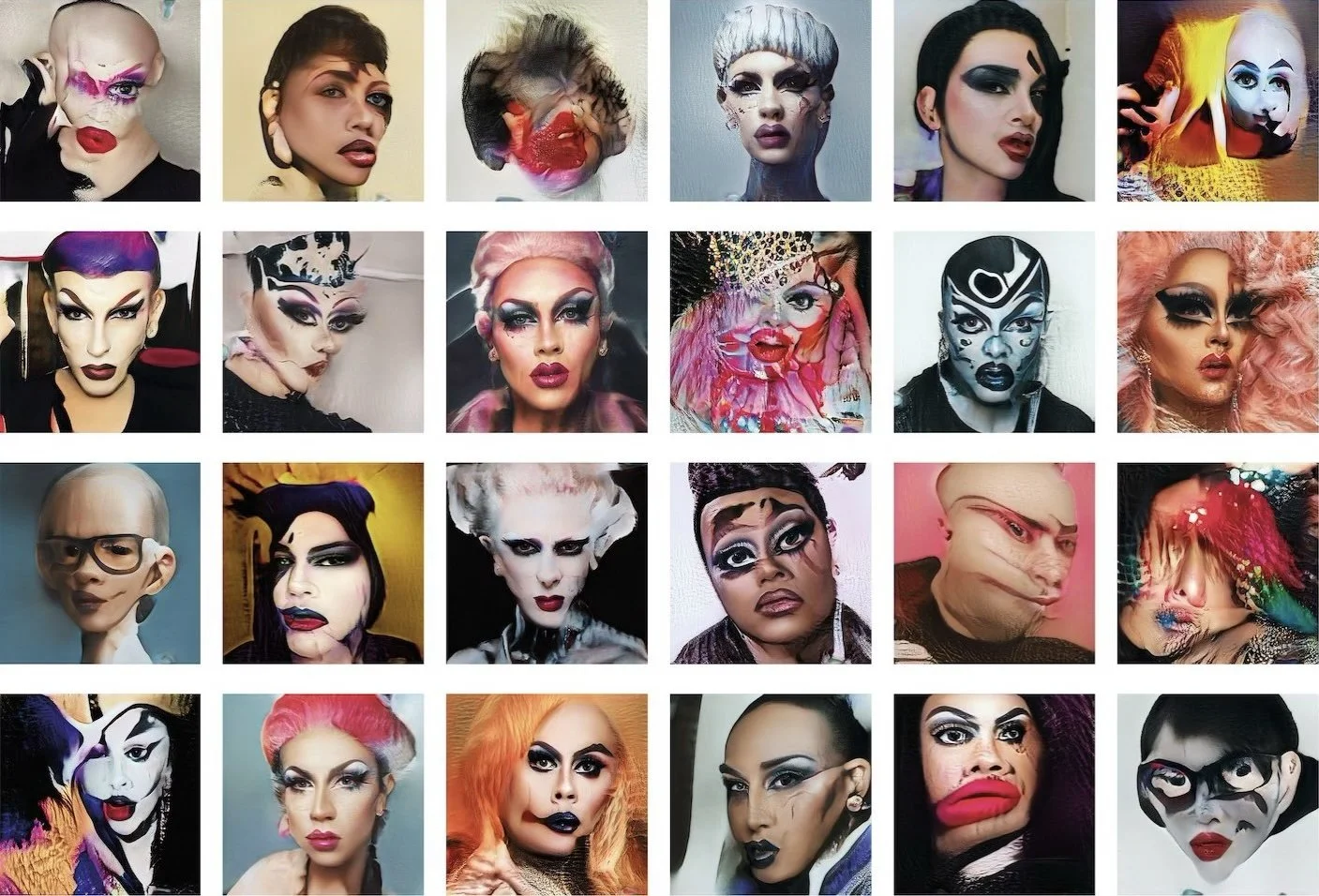
Jake Elwes, Zizi - Queering the Dataset, 2019. Series of 24 archival pigment prints on Platine Fibre Rag paper, 21 × 21 cm. Image source: Jake Elwes’ website.
This technical and creative exploration constitutes the first work in the broader Zizi Project and offers a first glimpse of the artistic strategy Elwes develops in response to discriminatory AI systems. By incorporating drag, an art form that plays with and exaggerates the codes of gender, Elwes introduces fluidity into systems otherwise structured around binary assumptions. At the same time, the colorful, excessive and approachable nature of drag stands in direct contrast to the perceived opacity and rigidity of AI systems. By bringing these seemingly opposing and unrelated forms together, Elwes seeks to demystify AI, making its underlying processes more legible, accessible and perceptible to the public. While Queering the Dataset begins this intervention by disrupting an existing dataset, the subsequent works in the Zizi Project, including Zizi & Me (2020-2023) and The Zizi Show (2020), take the experiment further in order to question not only who AI systems are capable of recognising, but also how the data used to represent those identities is produced, and on whose terms.
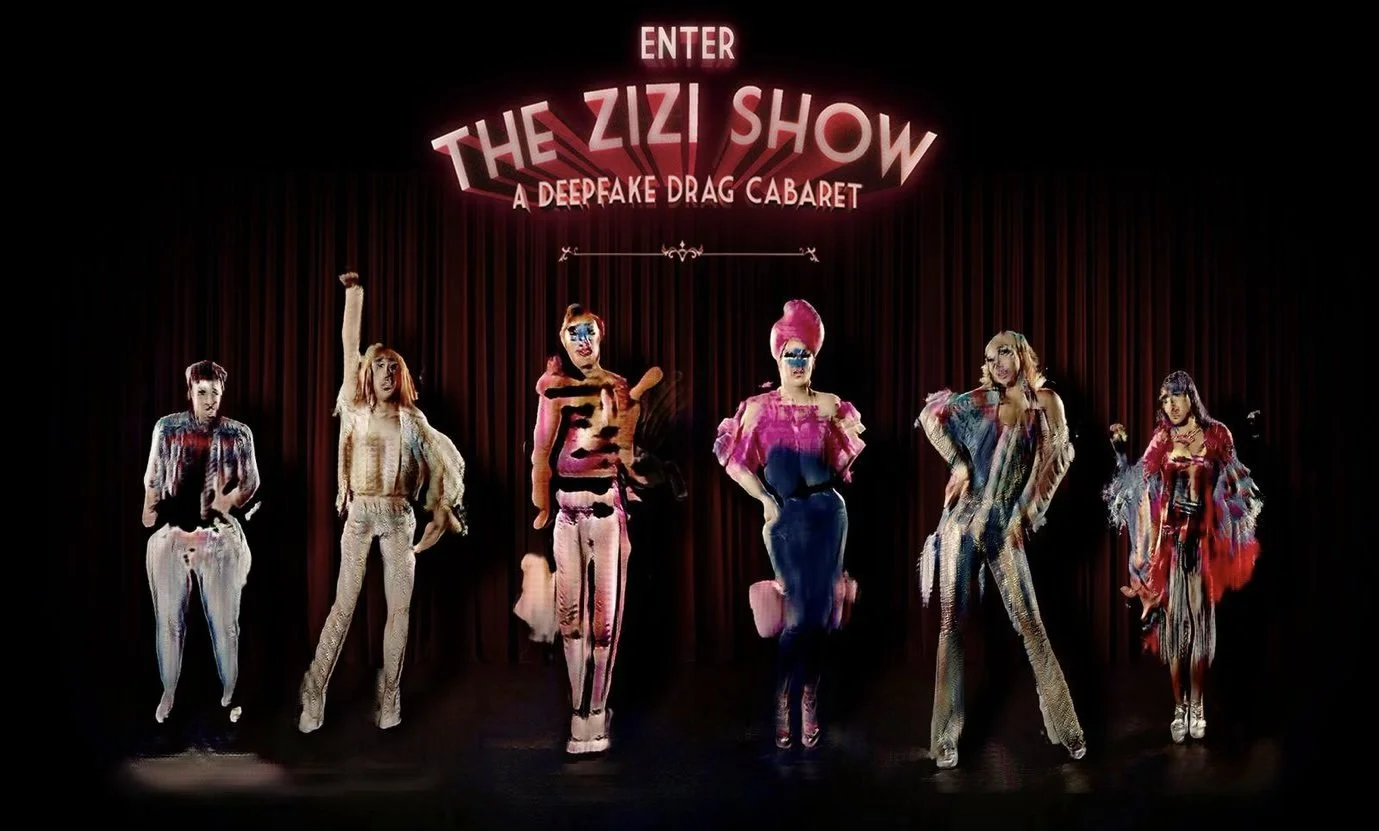
Jake Elwes, The Zizi Show, 2020. Web interface of the interactive deepfake drag cabaret. Image source: Jake Elwes’ website.
The Zizi Show
In The Zizi Show (2020), Elwes turns to deepfake technology and creates an interactive deepfake cabaret that includes thirteen well-known London-based drag queens, kings, and performers, producing a digital drag show. The name Zizi comes from the combination of z-vector, a set of numerical values that AI uses, and the gender-neutral “ze” pronoun. Produced in the form of a web app, the show invites the audience to participate by choosing who they want to see performing and to which song. Within this digital space, the show is set on a virtual stage against a dark velvet curtain, recreating an ambiance similar to that of a real cabaret. Once the user starts the experience, an introductory video plays, explaining what to expect, how the interaction works, and briefly addressing the critical issues highlighted by the work, all through a playful narration. Then, on the right side of the screen, the drag performers appear for the user to select, followed by a song selection. At any moment during the show, these choices can be changed and different configurations can be explored. To construct the experience, Elwes filmed each of the thirteen performers and used the footage to create a dataset. Through skeleton tracking, a process that maps key points of the body to capture its posture and movement, the performers’ movements were translated into data points that could then animate their deepfake counterparts. This allowed appearance and movement to be separated: one performer’s movements could animate another performer’s generated image. Lastly, as a fourteenth option, Elwes created a model trained on all of the performers’ bodies, combining them into a single deepfake identity that brought together features from each drag performer.
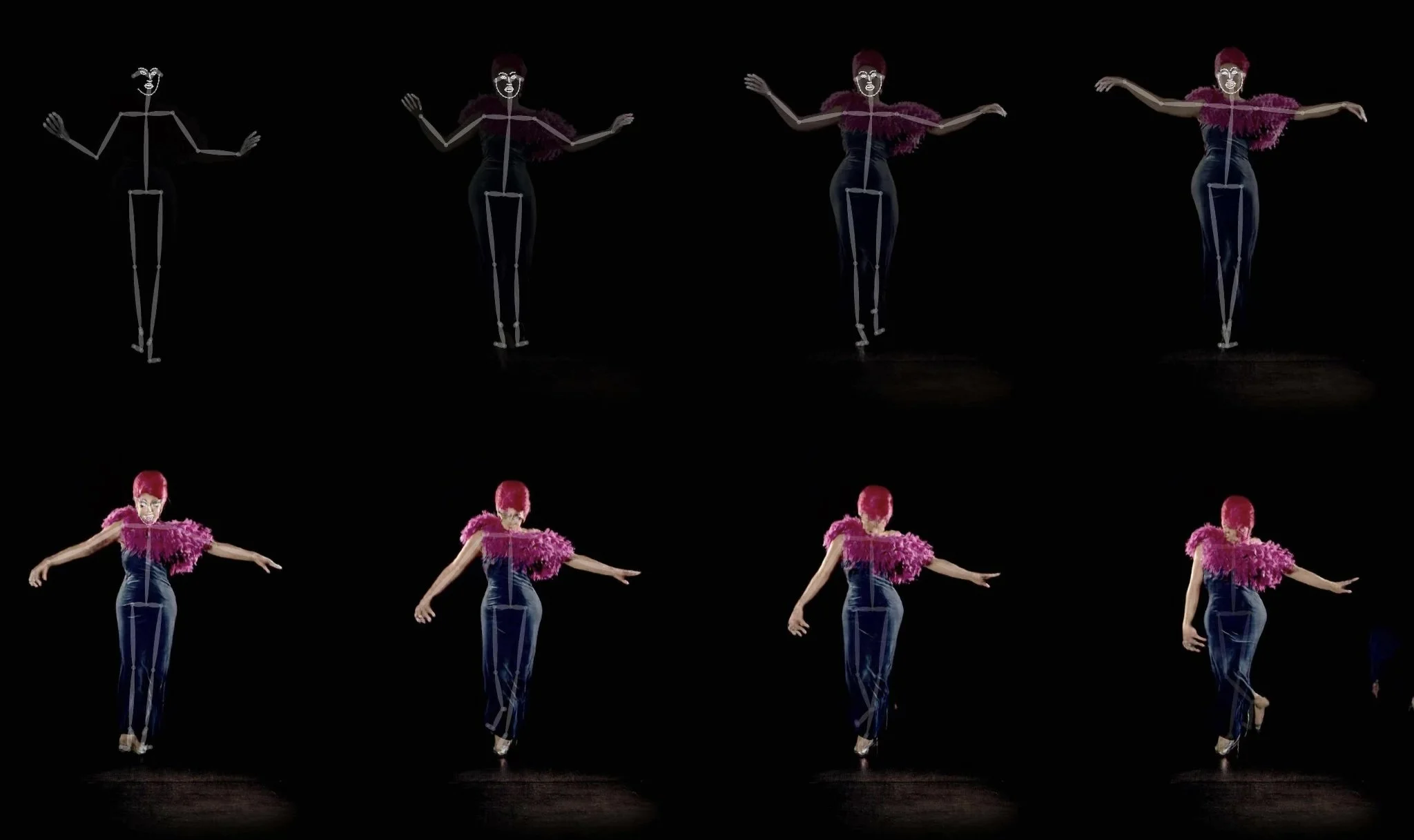
Jake Elwes, The Zizi Show, 2020. Image source: Jake Elwes’ website.
Why pair drag with deepfake technology?
It is not incidental that Elwes chose to work with drag performers in the context of deepfake technologies; they themselves point to the parallel between the two, noting that both involve forms of identity construction and transformation. While deepfakes technically manipulate and reconstruct appearances, drag performs this construction through visual spectacle, particularly by exaggerating and destabilizing gender norms. When these two forms are brought together, the identities generated by the system become more fluid, experimental, and difficult to reduce to fixed visual categories. Meanwhile, Elwes’ vision in creating a deepfake drag show also challenges the conditions under which deepfakes are often produced and circulated. Elwes asks how deepfake technologies might be used as performance tools to empower marginalized communities, in contrast to the exploitative and harmful ways they are often mobilized, particularly when a person’s image is used without their knowledge or control. To do so, The Zizi Show places diversity, consent and collaboration at the center of the process. The performers were carefully selected across different backgrounds in terms of gender, race, sexuality, and performance style, while their consent was prioritized throughout the production and use of their deepfakes. Elwes also made sure that the performers understood the technology and the critical issues the work aimed to address, and that they were paid for their participation. In this sense, Elwes not only considers who gets represented through deepfake technologies, but also reconsiders the conditions under which queer identities are turned into data in the first place.
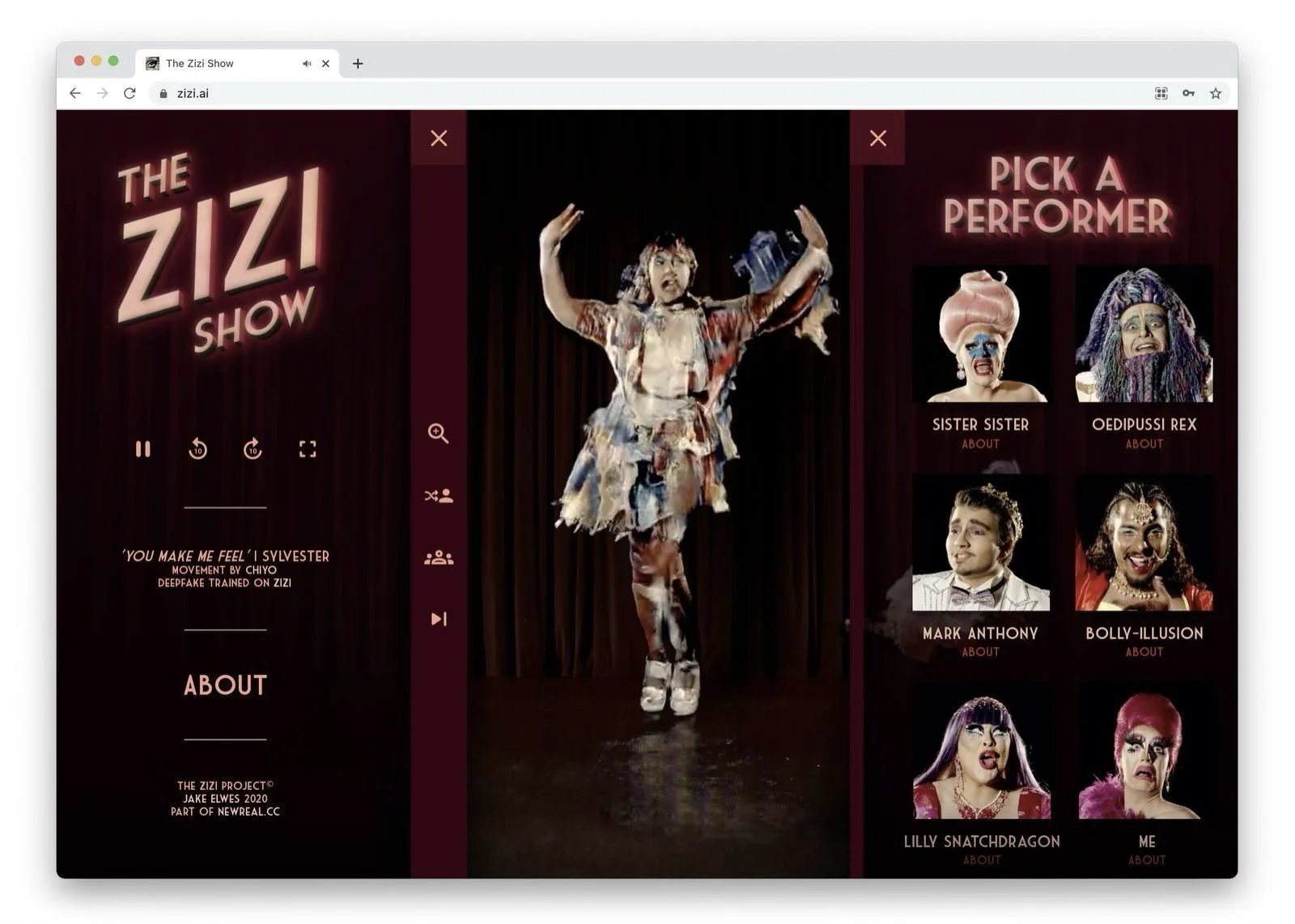
Jake Elwes, The Zizi Show, 2020, stills from the web interface of the interactive deepfake drag cabaret. Image source: Jake Elwes’ website.
As a result of the diversity of the cast and the glamorous nature of drag, the Zizi Show becomes a vibrant and playful experience in which each performer has a unique style, both in appearance and in gesture. The outfits vary from suits and sophisticated dresses with extravagant jewelry to special costumes or traditional ornaments. While some of the performers appear in enormous colorful wigs, others appear in elaborate makeup, or sometimes both. This mix of constructed identities, both through drag and deepfake technology, creates the essence of this flamboyant show. However, it is not a visually seamless experience. Throughout the performances, there are moments when bodies are visibly reduced to their skeleton form, confronting the viewer with technical instabilities, or glitches, that expose the construction of the deepfakes and remind them that what they are seeing is artificial. This happens when the system encounters a movement that it does not recognise well, or that falls outside the limits of its training dataset. For example, when performers move in more extreme ways, the system fails to recognise these movements, causing the deepfake image to break down. The body stops being recognisable as a coherent human figure and instead becomes fractured, semi-transparent and saturated with mixed colors. Most of the figures seem to liquefy onto the floor, while others remain visible only through isolated parts of their limbs.
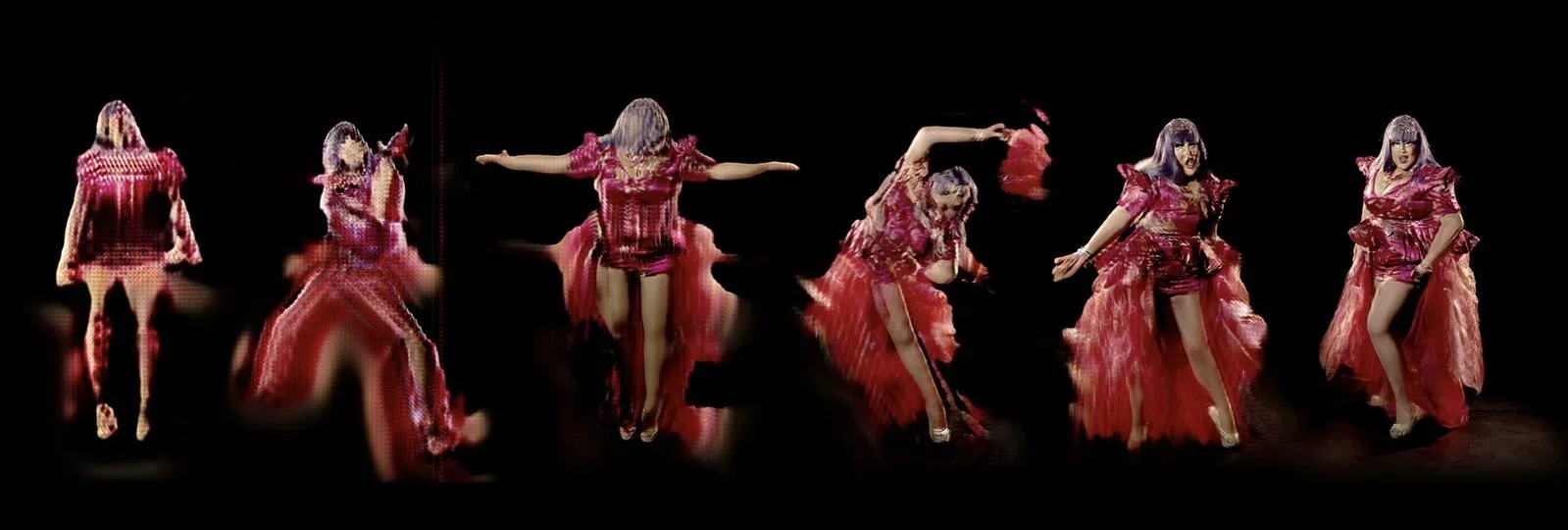
The Zizi Show (2020), montage of a deepfake training on drag queen Lilly Snatchdragon. Image source: Jake Elwes’ website.
Glitch as a queer strategy
Legacy Russell’s Glitch Feminism offers another way of looking at these moments of breakdown. Rather than treating the glitch simply as a technical failure or mistake, Russell considers its potential as a space for experimentation and resistance. Read in relation to discriminatory structures embedded in AI systems, Russell’s perspective offers a way of understanding technological failure not only as constraining, but also as a site from which to push back. Within this framework, Elwes uses the glitches produced by the system to expose its limitations. Rather than concealing the resulting breakdown, they allow it to become part of the aesthetic experience. In this technical and visual brokenness, a new potential emerges for reclaiming these technologies by making the conditions under which they operate visible. Just as a movement can fall outside what the model has learned, and therefore fail to be recognised by the system, queer and non-binary bodies may remain excluded from technologies shaped by those who hold social and technological power. By exposing and aestheticising these glitches, Elwes turns technological breakdown into a queer artistic strategy.
Concluding Reflections
The Zizi Show is a beautiful example of how artists can intervene in emerging technological systems that reproduce inequalities and structural discrimination. Elwes’ work not only exposes the problems surrounding these systems, but also offers alternative ways of engaging with them. Rather than simply inserting queer identities into existing AI structures, Elwes draws on drag and members of the queer community to disrupt their normative logic, while creating new datasets through collaboration, consent and participation. In this sense, drag becomes more than a means of representation: it becomes a way of challenging the system from within and creating greater agency over the terms through which queer identities become data. Elwes therefore does not simply ask how queer identities can be included in AI, but how queer artistic practice can reshape the terms on which these technologies see, classify and represent them.
Burcu Konuralp (b. 1999, Istanbul) is a recent Master’s graduate in Gender Studies from Paris 1 Panthéon-Sorbonne. Her Master’s thesis examines how contemporary artists engage critically with AI technologies, particularly in relation to gendered and racial algorithmic bias. Her broader research explores how emerging technologies reshape representation, visibility, gender-based violence, and relations of power in contemporary society.